
Have you ever wondered what it would be like to take a baby on a fourteen-hour flight? To be the holder of the screaming child that drives everyone else on the plane nuts? Probably not. Most of us prefer being the annoyed nearby passengers than the beleaguered parents. Nonetheless, Sai decided to try the latter position, as we embarked on a flight from DC to Tokyo with Teddy, our ten-month old son. Forgive me if this tale annoys you. At least you didn’t have to hear him howling like the other friendly fliers alongside us for the rides, to and fro, as we didn’t settle in Japan.
But can I say anything bad about our little angel? Only if I’m being honest. See Day 0 (and the return on Day 11) for the full-throated fury of Teddy in flight.
Ironically, I once wrote about another trip:
“The first flight was a lot of fun, even if a little late. Ears were popping, not from pressure, but from a demonic screaming baby who angrily awoke as the plane screamed down the runway. Infanticide may sound wrong, but the sounds of Damian didn’t sound right, and I’m pretty sure I was not alone in thinking homicidal thoughts. Alas, I took no actual action, as my impulses of ill will went unfulfilled. The banshee babe was based in Row Seven to Sai’s seat in Six, and my spot in Eight, so we were equally entertained. The only positive, ear piercing note struck by this arrangement was that the little devil may have helped encourage the girlfriend to envision a future devoid of kids. That fucking brat surely scored my vote for contraception.” – 2009 trip to Argentina.
Do you believe in karma?
First, some fun facts for you. Did you know that there is more to Asia than just Thailand? In my three previous trips to the great big continent, I only visited the one small country (first, to taste the smelly fruits of the land of smiles; second, to meet the family of the girlfriend (I met her stateside, after the initial solo trip); third, to marry the same girl in a confusing ceremony where I was led around like a clueless fool – wear this, sit here, don’t eat that, give this person money; there’s got to be a word for it – oh yeah, husband). Rather than returning for a fourth visit, the boss proposed we instead go somewhere else, not quite as far, and have her family fly over to meet us there. Like the good employee / husband that I am, I went along with the plan. Ironically, Japan is even smaller than Thailand (in terms of area; it’s smaller than California). Guess I’m picking off Asia in tiny pieces.
The island nation of Japan is jap-packed with 128 million people, most of whom are crammed into Tokyo*, or so it seems (California has roughly 40 million people, give or take a few million illegal Hillary voters). It’s a good thing the Japanese people are small (except for their sumoans; more on them later. Just know that these few finely tuned athletes resemble the average American). Japan is an old nation, having been around since the early 8th Century**, back when good old USA was just a bunch of yet to be insulted redskins, awaiting some diseased Europeans to bring slaves and germs and trinkets eight centuries later, followed by disappointing football approximately five centuries after that (the Eagles finally won one recently, so I can talk a little trash).
*[I found varying numbers for Tokyo’s population, ranging from 8 to 38 million people, depending on which website you want to trust, if they’re including the whole metropolitan area, etc. It’s either the biggest city in the world, or not. But whatever, it’s a lot of people.]
** [I’m going with their Nara Period for its national inception, when they were first centralized with this capital city, before it was overrun with deer. The land itself goes back longer, but like the silent tree falling in the forest, it does not officially count until imperial forces recognize it as a force to be reckoned with; otherwise, it’s just dead wood and dumb deer.]
The Japanese don’t call Japan Japan. Nippon is their name of the same. Apparently it is another thing lost in translation, beyond just Bill Murray and ScarJo. 98% of their massive population is pure Japanese. This is like a Trump / Bannon wet dream, only with Asians instead of their master race (orange / blotchy). It is the land of the rising sun, because they don’t respect anybody to their east. Japan (sorry Nippon, but no one outside of your nationalistic 98% purebreds cares if I call it that) is a shit-ton of tiny islands, with some much bigger ones that make up the bulk. 6,800+ = shit-ton, in case you were wondering. Honshu is the home of Tokyo, Kyoto, and everywhere else we would explore on our trip, so apologies to the other shit-ton less one islands that did not make the cut this time around. [Before there is an uproar, please note that I said “shit-ton”, not “shit-hole.” No disrespect! Not all Americans are that rude; just our highest elected dude (I didn’t vote for him).]
And yes, you can take the sad liberal out of America, but he’ll still hate the current administration and make a lot of cheap Trump digs. As always, you get what you pay for, and this shit is free (until I can find a way to get people to pay to not read my stuff). But I promise, no more than two political rants per day, on average, starting now.
Day 0 – Saturday, April 14th 2018 – Fly Away
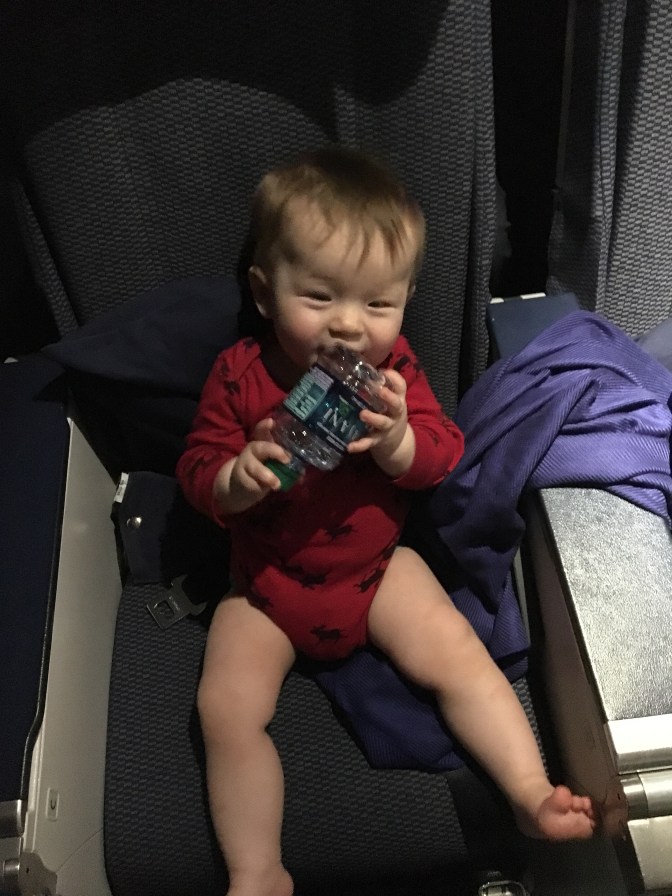
Aren’t angels supposed to be better at flying? Teddy started out strong, napping during taxi and takeoff. The first two hours passed quickly and quietly, and then the beast awoke.
Getting seated early was nice, and the special bassinet row with its unlimited* legroom ruled (*for short people like us; I had to fully extend my legs to touch the wall in front). And the discounted ticket price for Teddy is enticing. But that’s where the perks end. Unless you’ve gone for the mile-high club (good for you, I guess), you’ve probably never tried to cram more than yourself into the cramped plane lavatory. Because Teddy has become so adept at flipping over during diaper changes, Sai insisted we tag-team these efforts, so we both squeezed in around the flailing babe, with his flying feet and arms aswinging, his poor parents trying to diaper our darling, while he did everything in his surprising power (you wouldn’t expect as much fight from a twenty pounder, unless he’s a carp (I confess I had to google to find an apt fighting fish in the proper weight range)) to keep unclothed.
Back in our seats, the conscious boy refused the base of his own bassinet. I couldn’t really blame him, as it did seem a bit cloistering, the little, lonely casket so much less inviting than mommy or daddy’s lap.
He had his occasional outbursts, sharing his strong lungs with our surrounding passengers. And every object he was given, was quickly given to fly, usually landing on the floor of the plane, though a pacifier was once caught by the flyer behind us, and a large lovin’ spoonful of nuclear orange carrots ended up on daddy. My plan to pack light just lost its first pair of jeans in the first few hours.
In short, for a long flight, he was sky-high maintenance. I expected more maturity. He’s almost ten months old, for crying out loud, like he did repeatedly. Teddy did turn on the charm for the flight attendants though, smiling and laughing for them, a charm offensive he’d continue to exploit throughout the trip with other attractive Asian women (they clearly reminded him of mommy).
PRC (Political Rant Count, not to be confused with the People’s Republic of China) = 0! It’s hard to wax political when all we were doing was flying. Of course, if we were in the Trump administration (or familia), we would have flown first class and brought heavy security, at the taxpayers’ expense. More like stock the swamp with fresh swamp creatures.
[Updated PRC = 1 (so close!).]
Day 1 – Sunday – Arrive in Tokyo
Konnichiwa!! That means hello in Japanese, or something more obnoxious if your name is Zinke. Hey Ryan, kutabare yatsu! (That means something a little less polite than hello).
A mere fourteen hours after boarding the aircraft, we arrived at Narita, a large airport a ways away from Tokyo, at least to those who don’t know their ways. Sai was impressed at how efficient border control operated, though I saw no difference from the slow march of bodies you’d find after any other international flight. I think she might have an Asian bias. To be fair, so do I.
Bathroom Humor
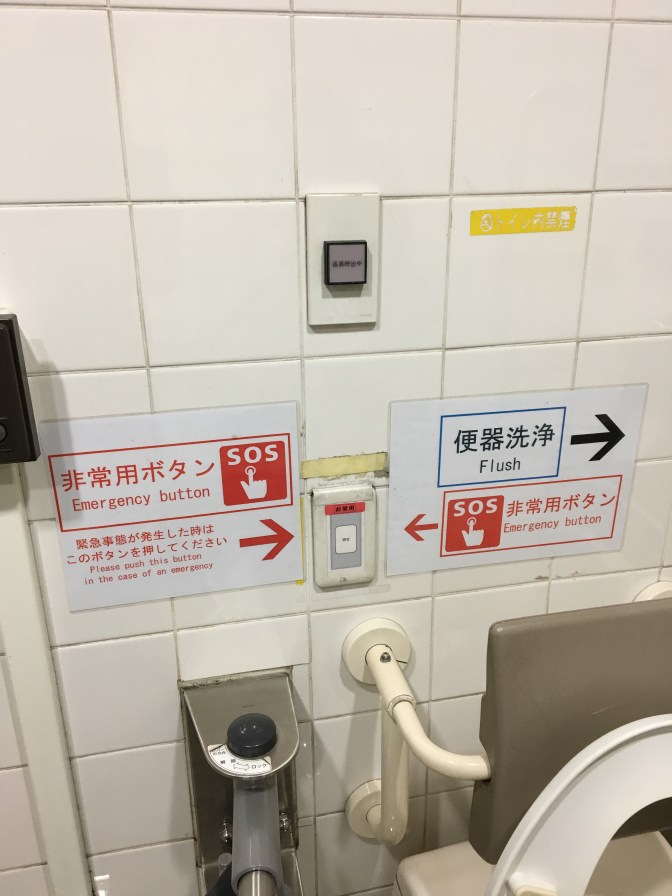
After collecting our bags, we made another fun family trip to the toilet (this one much larger than the airborne version) for yet another diaper change, since Teddy stubbornly refuses to do it himself. I also availed myself of their gizmo-laden water closet, and my simple piss seemingly started an international incident! (Wish I had that taxpayer paid security now). There were more bells and whistles and buttons and lights, hoses and nozzles around the porcelain bowl than I could even begin to understand, even if they’d have been labeled in English, which they weren’t, save for the remote toggle tagged “FLUSH.” Before finding that one, I’d depressed a few other more blatant buttons, starting with the orange one closest to the toilet. [There are other square appurtenances I saw in several bathrooms that were either some sort of sink, or oddly sized and awkwardly placed urinals. Rather than washing my hands in the pisser or pissing in these little sinks, I found it best to avoid them.] The orange button seemed the most captain obvious to me (always keep your flusher close), but nothing seemed to happen when pressed, so I pressed on moving outwardly pushing inward buttons made in Japan until finding the farther out aforementioned FLUSH. WHOOSH!! Problem solved, pee disappeared, Teddy newly diapered, we figured out the OPEN button (written in funny Japanese lettering, but we’re getting better at figuring these things out, after a few NOPE buttons), when outside the door was an awaiting army of security and staff wanting to know why I’d pressed one of the buttons that apparently silently summons an army of security and staff. The Japanese are extremely polite; rather than barging in or knocking, they merely waited for us to come tell them that there was no real emergency, unless you consider an idiot American tourist unable to read the word FLUSH an emergency. My fears of torture went unfounded (the Japanese have seemingly mellowed since their brutal ways in Hillenbrand’s “Unbroken”).
Why is working a Japanese bathroom more technical than an airplane’s controls? It’s rumored that Amelia Earhart stopped at Narita on her last flight and got trapped in a ridiculously complicated Japanese toilet, only to be never heard from again. If only the security had knocked rather than waiting, Lady Lindy might not have been forever lost. Anyway, I won’t be manning the controls of any aircraft anytime soon, and to be safe, I vowed not to flush for the rest of the trip.
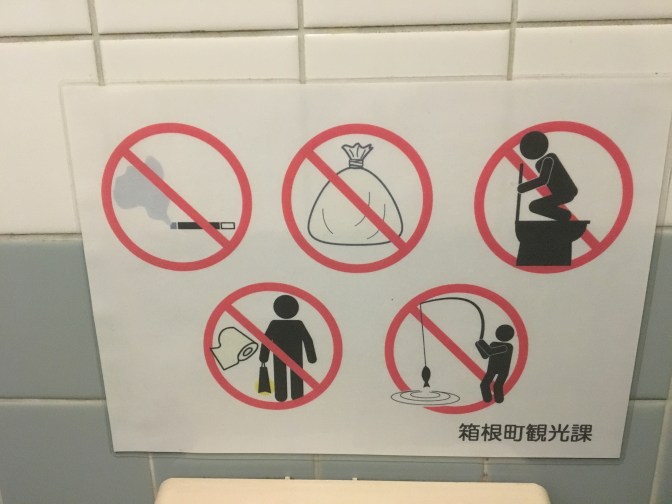
[While we’re on the subject (can we change the subject now?) of Japanese toilets, a quick tangent. At a later stop (I know it’s cheating to jump ahead, but I figured this a good place to tie this toilet tale together), a much simpler bathroom featured pictographs illustrating five no-nos for using their commode. Reference image below. In order, the first prohibited smoking in the boys’ room (the Japanese clearly hate Motley Crue). Second, no dumping trash into the toilet (an image of a garbage bag in the circle with the strikethrough). Alternatively, they may have been telling you not to package up your shit to take with you. Third, either no standing on the seat and squatting like a retard or a Chinese person (apologies to both), or they may have been barring humping the seat lid. Again, no problem, I wasn’t in the mood for lid humping at that time anyway. Fourth, no stealing toilet paper or using your briefcase as TP, which I can’t imagine anyone doing, but then again, until the image before, I never thought anyone would hump the lid either. Finally, no fishing in the toilet. Is toilet fishing really a thing?]
I had mapped out detailed directions from the airport to our hotel via Japan’s super-efficient subway system. So when Sai said we were taking the bus, those directions proved worthless unless used as toilet paper from my briefcase, which makes a little more sense than using the briefcase itself as toilet paper, now that I think about it. Needless to say, we struggled to find our way. Eventually, we located our tiny fourteen story building in the Shinjuku neighborhood, dwarfed by the much taller scrapers of the night sky around it. No daylight savings time plus a long bus ride from Narita meant that our early afternoon arrival did not get us there until after dark.
By the time we were settled in, around six p.m. local (or five a.m. by our internal DC clocks), we had competing agendas to deal with. Out and about in our nearby busy surrounds, Teddy started fading fast, falling fast asleep atop his stroller. Sai sought food, while all I wanted was a workable washroom for me to use without incident. One of the many megamalls offered me sweet relief of a Godzilla-sized load. I still feel bad for whatever poor sap followed after me into that stall and found it, since as I’ve noted, no more flushing. Wouldn’t want to risk accidentally hitting the eject button, or opening the door only to find the waiting guards saying something to the effect of “You again?!”, not that I’d understand them.
We found food at a local hole in the wall with appetizing pictures on their menu to accompany their indecipherable names in funny characters. Anybody else ever notice that Space Invaders characters look like Japanese letters? 東京 = Tokyo, or something you’d want to shoot out of the Atari sky. Food was food, and off to bed for Ted, when he decided to tell us in not so many words as actions that if the flight from hell was not bad enough (it really wasn’t that bad), then prepare for a night of hell. His preferred method for overcoming jetlag is to scream and cry and kick and pound on the walls and to stay up all night because his earlier antics of acting sleepy were just a ruse. You’d think that at least this time he could only keep his parents up, as opposed to a plane full of people, except I’m pretty sure our neighboring rooms (and buildings) could still hear crying Teddy.
PRC = 1.5 (the security reference was really just a throwback to the earlier dig from Day 0, so it only counts for half).
Day 2 – Monday – Tokyo Arose
We awoke later than planned on Monday, a theme that would recur throughout our trip in no small part due to a traveler named Ted who liked to wake much earlier to jump around for an hour or two (typically sometime between 3:30 and 6), before settling back down for a later, formal effort by all parties to actually get out of bed (or off the floor mat, depending on which type of arrangement we were staying at).
When Worlds Collide
When you think of Japan, you expect sumo wrestling to be as ubiquitous as baseball, a national pastime that is unavoidable and overrated. At least I do. Sumo – the ancient art of fat people fighting, has been a big thing in Japanese culture since the age of Sumer*, though I’ve read its popularity is on the decline. (*Actually, I’m not sure how long Sumo has been a big thing, since I skipped the Sumo Museum after reading that it is lame, but it’s old and I seriously doubt it came from Mesopotamia).
I hadn’t seen any good fat people fighting since the last time my whole family got together for Christmas, and I wanted to see how the professionals do it for comparison. Unfortunately, the official sumo schedule only has the big guys chest bumping every other (odd) month, and April was evenly out of the competition. But then I discovered a special event in April, in Tokyo, at the Yasukuni Shrine, that happened to be free, and was being held on the Monday after we arrived. Clearly the sumo gods were smiling upon us. (Did you know that in Japan, they tell young children that thunder is the sound of sumo gods wrestling? I bet you didn’t, because I just made that up. The Japanese are into Shinto and Buddhism, and they use a normal-sized Buddha (as opposed to the fat, happy Chinese Jabba Buddha), who would make a sorry Sumerian, even if he wanted to forego his otherwise passive nature).
FYI – The Yasukuni Shrine is dedicated to those who gave their lives in the wars of Japan, including war criminals. It is a controversial place, but we gave no homage to any of the enshrined souls, instead focusing on the Sumorai, living fighters without weapons beyond weight beyond belief. I guess it’s like statues of confederate soldiers in America, only if they were mixed in at Arlington National Cemetery. Most of the people who gave their lives were not considered war criminals, but add a few to the mix, and it pisses off China and the Koreas.
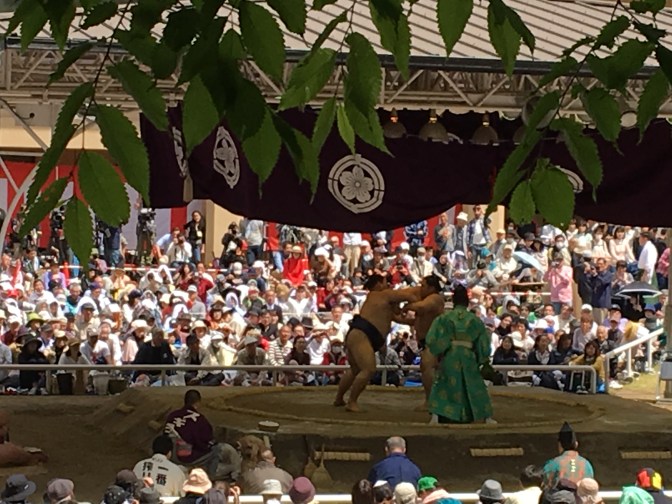
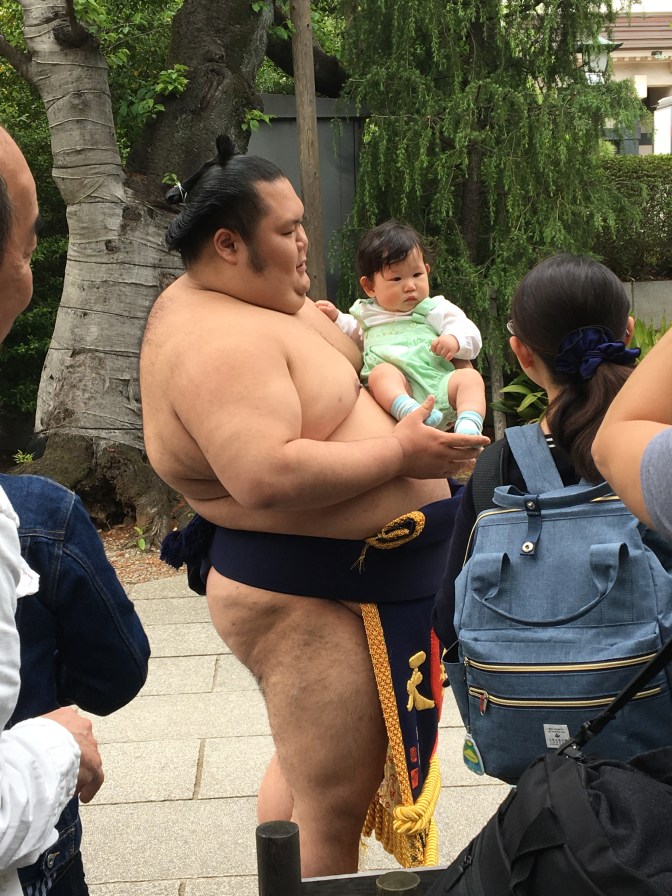
Yasukuni hosts a big, ceremonial sumo sampling, starting at 9 am and filling fast. We arrived a little after noon, and were lucky to find a few inches of space in the very back, under a tree. We could still see the stage / dais / ring, and the big boys were hard to miss. We settled in under our standing tree (both we, Sai and me, and the tree were standing, though Teddy, who is relatively new to the whole standing thing was instead sleeping, strapped to my chest in a baby bjorn type carrier. No wonder the sport’s standing is declining, when the kids today fall asleep watching. It’s like golf before and after Tiger. Though in fairness to these professionals, the packed house showed enough persistent interest, at least for a free event).
When we arrived, a group of giants circled the circular ring, dancing and chanting and not fighting, so I was confused. After ten minutes of this, their hemi-godly offering or whatever the hell it was wound down, and they filed out of the ring in a giant parade reminiscent of the last time I went to a Pizza Hut buffet. Next, two big comedians came into the ring, and entertained the crowd for the next twenty minutes or so with staged demonstrations of sumo moves, exaggerations of its elements, and goofy plays on each other and the crowd. Picture WWE meets Harlem Globetrotters. For instance, they’d take turns tossing the other guy out of the ring with shocking force and impressive agility (you wouldn’t expect someone that big to tuck and roll nimbly rather than thudding like a thunderclap). They’d jokingly go from tossing salt into the ring to tossing it at the other guy. There was a bit where they spit on each other. And a time when they all walked out into the audience and each stole some guy’s beer (including the ref, who chugged an entire can). It was a nice comical interlude between the weird ritual and the real fights that would follow.
Next, pairs of fighters entered, squared up, threw salt into the ring, did that wide-legged squat pose where they raise one tree trunk at a time before slamming it down and raising the opposite leg, and then, ahead of the bell (actually the ref giving a wave and a “HiYah!” – Japanese for go or something), right as you’re bracing for the heavy impact, they’d step out of the batter’s box and return to opposite sides. They’d get salty again and repeat, again facing off, and again walking off. WTF? But on the third go, they’d finally go, and theatrics complete, compete. It took me a bunch of matches to catch on, each time expecting them to go on the first or second face-off before learning that it was always a setup.
Finally, Action!! Two big men in thongs charge each other and slam together like the biggest, loudest skin on skin chest bump you’ve ever seen and heard, before grappling with each other’s diaper, trying to gain leverage or give an atomic wedgie, pushing to the edge of the elevated ring mound, where the pushee would strain every muscle in his super strong calves to hang on, pushing back (forward), fighting for a momentary letup in the other guy’s effort to allow an escape back towards center, or a shift in center of gravity to throw off the opponent’s balance and to hopefully throw him out of the ring or to trip him up. To win, you have to get your opponent out of the ring first, or off his feet. It’s like a reverse tug of war, where you push instead of pulling, and there’s less risk of having your fingers severed.
Most bouts lasted less than ten seconds. The longest I saw clocked close to half a minute. Usually one wrestler would push just a bit harder, have the other on the edge, get the extra leverage, and shove both out. As long as the other guy goes out first, you win.
We must have watched around a dozen matches in a matter of minutes, because despite their preambles, the actual competitive brevity kept them coming. Sans Sai and Teddy who didn’t really seem to care, there’s no telling how long I might have stayed, particularly since they were selling beer on site (name me one professional sport viewing experience not enhanced with a few brews). But instead, I proposed we move on, as I had the flavor of the experience, and could check that box that I never knew was on my bucket list of things to do.
But when you’re visiting an exotic locale, there should be the big five boxes: tallest building, best museum, palace / castle, grandest church / temple, and local sporting event. For instance, in Paris – Eiffel Tower, Louvre, Versailles, Notre Dame, and frog licking. In DC, Washington Monument, Smithsonian, White House, National Cathedral, and watching the Capitals choke in the playoffs. Do these few things, and you can say you’ve experienced the place.
Asakusa
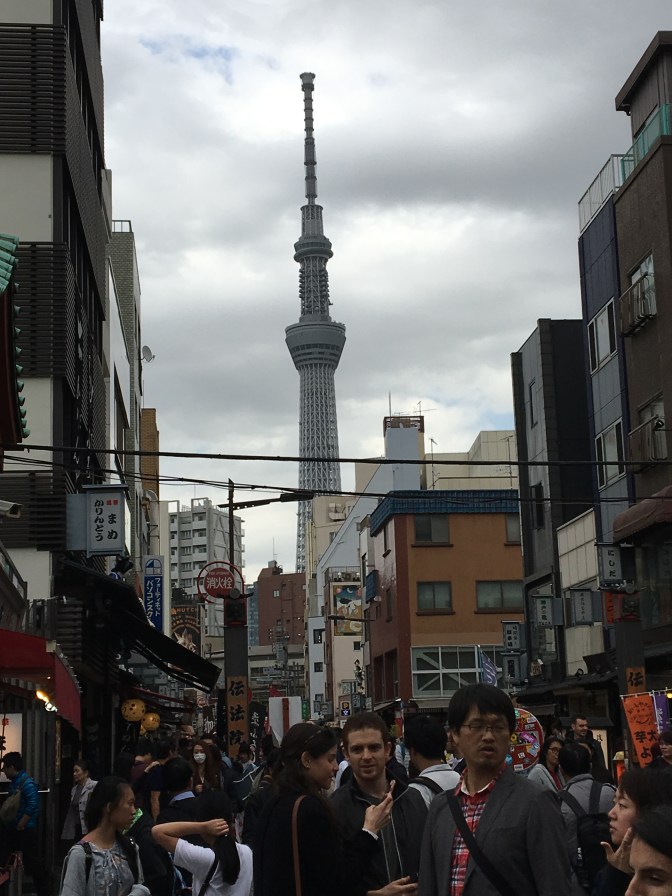
We headed over to Asakusa next, so Sai could start her shopping. She always pretended it was to find stuff for Teddy, to which Teddy rolled his eyes. (Since he’s young and not that coordinated, I spun him around so that his eyes would roll to get the point across.) We sampled all kinds of culinary snacks (Sai saw a store, took cash from me, and gave me some weird but tasty thing to eat, never once giving me any change). There’s an Asakusa Temple (Senso-ji), and it was a fine shrine, the first of many to be seen on this trip. More on the more interesting temples later (to wit: not necessarily more important or more impressive, just worthier of more words from me. I used up most of my day’s quota on the wrestlers). Senso-ji’s five-tiered pagoda just couldn’t compete with the Skytree.
Skytree
Looming over Asakusa is the Tokyo Skytree, which was more important to me (box number one – tallest building). Sai was unimpressed, and opted out of the excursion when I told her that it was roughly $40 to take the tourist express tour to the top viewing platform. Because they weren’t busy on this weekday, I was sent on the normal route instead of the special tourist extortion program. For a thousand yen less overall (more or less), you buy a ticket to the first viewing level, and then another ticket to the higher level, whereas the special pass sends you straight to the upper.
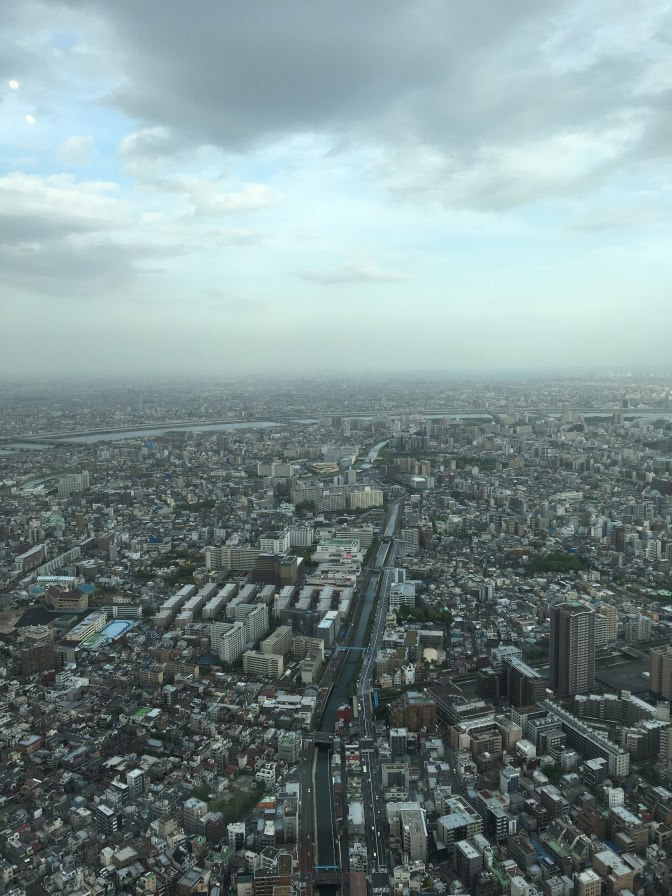
The Skytree is 634 meters tall, making it the tallest “tower” in the world. The tallest building (based on present wiki-facts as of this googling) is Dubai’s Burj Khalifa at 830 meters. The Washington Monument comes in just behind the Skytree at 555 meters. Wait, that’s 555 feet, or 169 meters. Sorry, George, your obelisk is tiny. Remember, size isn’t everything (as I keep telling myself). The Sears Tower (what you talkin’ bout Willis?) is a mere 442 meters. The Eiffel Tower is 324 meters, so the Skytree almost doubles the frog lickers. In short, the Skytree is tall. The first viewing platform is at 350 meters. The elevator accelerates to 600 m / minute, which is crazy fast, such that you’re up at the platform level in a matter of seconds, though it is a smooth ride, lacking the fun of an amusement park tower of terror on the rise or fall. But it definitely beats taking the stairs. From there, you can look down upon some otherwise impressively tall buildings (but it’s all relative), as well as appreciate just how expansive the city of Tokyo is. On a clear day, you can supposedly see Mount Fuji, but not today. In my momentary lapse of freedom, I grabbed a beer at the high bar before taking the next elevator to the upper platform. This second level ramps up from around 440 to 450 meters, spiraling around the narrowing structure with the glass viewing on the outside, and some weird Asian pop paraphernalia on the inside. All of my camera action was directed out. Even higher, still no signs of Fuji in the clouds (not even a blimp), and no upper bar, so it was time to move on. I was disappointed that the top 184 meters was off limits, but unless you’re King Kong, what can you do?
Teddy has a Ball
Upon rediscovering Sai and Teddy after leaving the tall Tree, Sai informed me that she had found something for Teddy (sumo was my idea, Asakusa was hers, Skytree for me, while she and he shopped some more for her, so he was due for some fun). Atop the mall next door to the Skytree is a children’s fun zone place where Teddy was able to play in a massive ball pit for the next hour. And as his supervisors, Sai and I were forced to play in a massive ball pit for that same hour, save for the ten minutes apiece we each spent in a massage chair while the other parent chased the child. I won’t say that it’s more interesting than Sumo or as impressive as the Skytree panorama, but for Teddy, it kicked some ass. It definitely kicked the kid’s ass, as he was exhausted after the hour of exercise, falling asleep as soon as we left.

I passed my first challenge of eating hot ramen over the head of a sleeping baby strapped to my chest. Those scorch marks on his scalp are birth defects; that’s my story, Child Services, and I’m sticking to it. Sai and I both fell asleep on the subway, as apparently playing in kids’ ball pits is too much exercise for us too, but luckily managed to find our stop and made it back to the hotel in time for an early end to the evening. At least we knew that Teddy would sleep through the night and be back to a normal sleep schedule!
At 4 a.m., Teddy told us otherwise.
PRC = 1 (Confederate statue comment).
Day 3 – Tuesday – Tokyo + Thai Family
Meiji and Me
We three started off our next day a little later than planned, courtesy of Teddy’s f&$#ed up sleep patterns, and headed to the Meiji Shrine for temple #3, if you’re counting. I gave up counting in Kyoto because these shrines are everywhere. Meiji was pretty, with a pretty impressive O Torii (grand shrine gate), “the biggest wooden “torii” of the Myojin style in Japan” according to the sign. These Toriis (not to be confused with those wigged British conservatives, (not to be confused with the Whigs)), are archways or framed openings under which you pass to enter into the sacred grounds of a shrine. It’s two vertical legs supporting two horizontal cross-members, with the top one curved concavely. If that description doesn’t do it for you, I’ve got pictures galore to show them after Day 7. But since there weren’t any sumo wrestlers around, we didn’t stay too long at this crowded shrine.
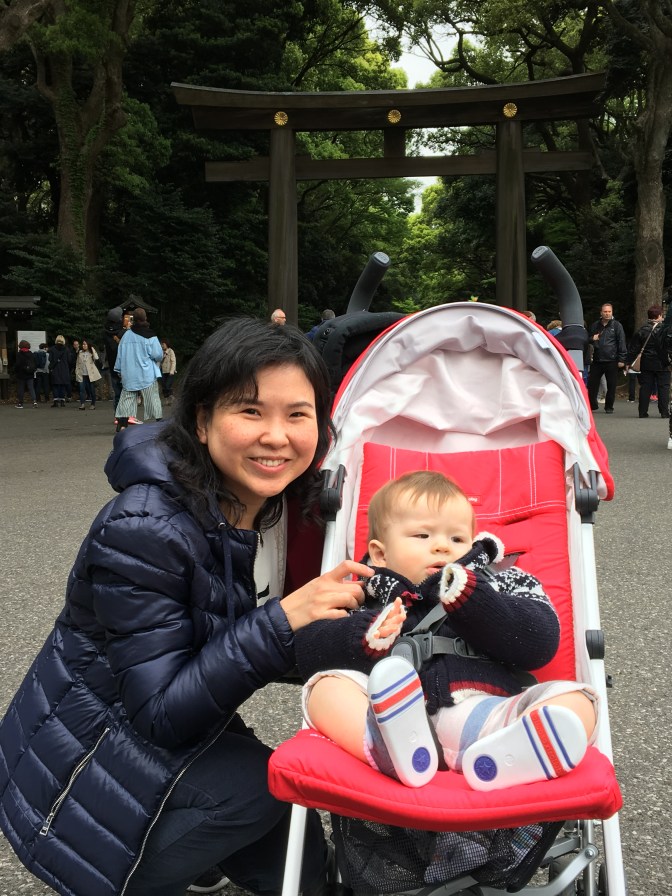
We ate takoyaki (octopus balls – that is to say wheat balls filled with octopus parts, not necessarily testicles) and taiyaki (a fish-shaped waffle stuffed with red beans or custard or chocolate or other sweet filling) from a busy corner store while waiting for the Wichgools to meet us. Sai’s parents and brother arrived, ate some takoyaki of their own, and we had six additional hands to help meet the ceaseless demands of Teddy (it takes a village, I hear). More importantly, Sai now had her brother to argue with over directions and destinations, and I could just relax and go along with the group.
Imperial Palace
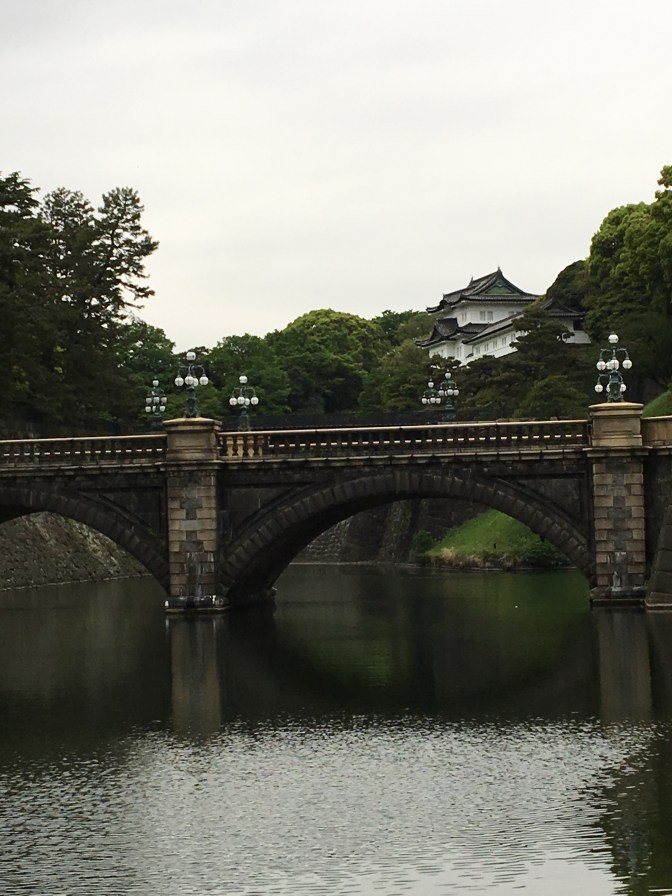
By now we’d checked off the tallest building, several shrines, and the sport of sumo, so we headed to the Imperial Palace to knock off another must-see attraction. I confess, I don’t see the attraction to this Imperial Palace. While it looked much nicer than the shithole hotel that used to disgrace the strip in Vegas (RIP IP LV), you can only glimpse the outlines of the building from a great distance. What a gyp! (Sorry gypsies – no offense). Can you imagine if you came to DC and wanted to see the White House (like people used to want to do) and could get no closer than a distant fence line through which you can only glimpse the building? That would suck, right? Well that’s all you get at Tokyo’s Imperial Palace. I can only presume that the inside of this place has the same cigarette burns, mildew, worn carpeting, and peeling paint as the old hotel in Vegas, which is why they won’t let people inside.
Because that’s all they care about, the Thai crew then led Ted and me across town to an old, popular basement ramen establishment. Our boy slept in the carrier that I was carrying for the entire commute, only to open his eyes and then his lungs for the entire tiny restaurant right before my food arrived. Drop a little ramen on a kid’s head one time, and they are scarred for life, and scared to death when you try to eat ramen again the next day with them in kangaroo pocket. (Seriously, I didn’t spill!) The place was set up with individual bays facing a tambour door which would roll open for the server to slide your pre-ordered bowl of noodles (and in my case a cold beer) out to you, before quickly shutting again to provide the most impersonal eating situation possible. I hoped that one of the Wichgools would eat fast and then come take Teddy (they were seated ahead of Sai and me), so that I could eat, but instead I held a screaming child with one arm, while trying to scarf down hot soup with the other, meanwhile trying to shush him and also keep him from spilling my beer. It was hard work. In a normal restaurant, you can pass the banshee baby around and take turns eating, or leave your seat to briefly entertain in a common area; at this place, everyone was seated separately, and it was such an assembly line setup (with a line up the steps, out the door and down the street) that I feared leaving my seat would mean losing my meat (and noodles and did I mention beer?). In other words, it was the worst meal of the trip at what was supposed to be one of the best places.
To make up for my disappointment, Sai let me see one of the other items high on my list of Tokyo interests.
Hachi!!
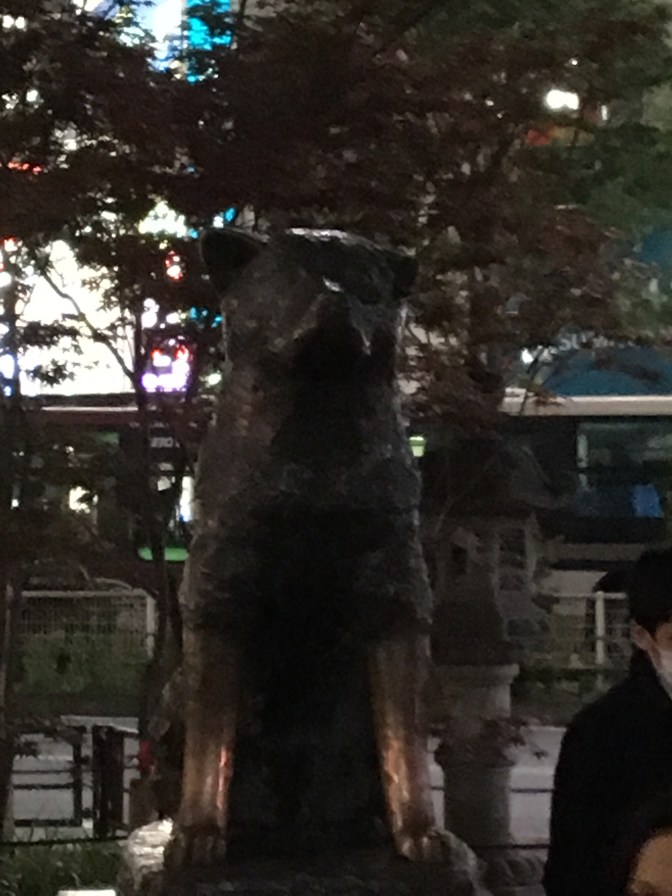
Hachiko was an Akita (Nipponese nipper, dog) who followed Richard Gere to the train station every morning, and came back on his own to wait for his return every evening, until Gere died of a brain hemorrhage caused by a gerbil and never came back, but Hachi continued coming back every day on his own for years, wondering why no one ever talked about Richard Gere’s untimely death, until a taxidermist planted his (Hachi’s) carcass at the station, which was then bronzed over and is a statue today. Wait, let me try this again. There was a real dog named Hachiko who used to wait for his master to return to the Shibuya Station every day. While one day his master died at work, the loyal dog persisted in continuing to come to the station to wait for him for (nine!) years, rain or shine or snow, undeterred by the elements or the passage of time, in the ultimate demonstration of loyalty. This was Trump’s kind of dog, unlike that lying, leaking Comey. Either that, or Hachi just really hated the dude’s wife (midogynist).
There have been movies and articles about the famous dog, including a version set in Rhode Island featuring Richard Gere as the dead master, in yet another instance of Hollywood whitewashing or cultural appropriation. At least the 2009 film kept the dog Japanese (Hachi: A Dog’s Tale). It’s a touching story, and Hachi has a statue at the Shibuya train station in Tokyo, as well as one at the station in Rhode Island used for the Americanized version. Sai made me watch the movie a few years ago, so I wanted to see the source (in statue form, since Hachiko died 83 years ago).
Shibuya is shi-crazy. There are so many people there, it again makes me question if Tokyo’s population is underreported. Shinjuku was crowded, but Shibuya has hundreds of people (I didn’t actually count) at every street crossing. It is an unbelievable mass of humanity. Unfortunately for me, the area around Hachiko seemed to be their main meeting point, so I couldn’t throw Teddy on top of the statue for a really cute picture. Besides, if I tried, I’m sure a certain young lady would be waiting to reprimand me immediately (more on her shortly).
Completely unrelated, save for American movies featuring Japanese characters: throughout my short time in Tokyo, I observed schoolgirls everywhere dressed like Gogo from Kill Bill: Volume 1. These young ladies scared the hell out of me. Thanks Quentin. I didn’t see any yakuza or Crazy 88s, just Gogo girls. None of them were swinging meteor hammers (or chain mace) at least.
PRC = 2 (not counting the Hillary book title borrowed).
Day 4 – Wednesday – Hakone
With the full group in motion, we stymied every elevator getting through the public transportation hubs of Tokyo (five large suitcases, one stroller, two duffels, one baby and two septuagenarians in addition to me, Sai and her brother – we were not taking the stairs). We loaded our first Shinkansen to get from Tokyo to Odawara, whence we’d move to much slower modes of transport for the balance of the trip to Hakone / Gora.
Shinkansen Shit
Shinkansen is Japanese for “shit that’s fast!” The high-speed rail traverses most of Japan, and is a model for how efficient a well-run train system can get you around. Think Amtrak, only nothing like that. A sixteen car train with a hundred seats in a car (less seats in the first class “green seats”) whisks into the station two minutes before scheduled departure, is fully loaded, and flying down the tracks before people have taken their seats, right on time. Compare that to air travel where the boarding alone takes thirty minutes, taxiing, unloading, waiting for luggage, etc., and the travel time extends to hours longer than the actual flight time. Add in decent legroom and nice big windows and it’s no contest. I would take that speed train every time (except for international travel, until the tunnels are expanded). For international visitors, there is also the JR (Japan Rail) Pass, a seven-day open ticket for most trains, including some local rails in the bigger cities (such as Tokyo and Kyoto). We would utilize this pass for travel between Hakone and Kyoto, Kyoto – Hiroshima – Osaka – Kyoto (or Kyoto – Nara), Kyoto – Tokyo, and finally Tokyo – Narita.
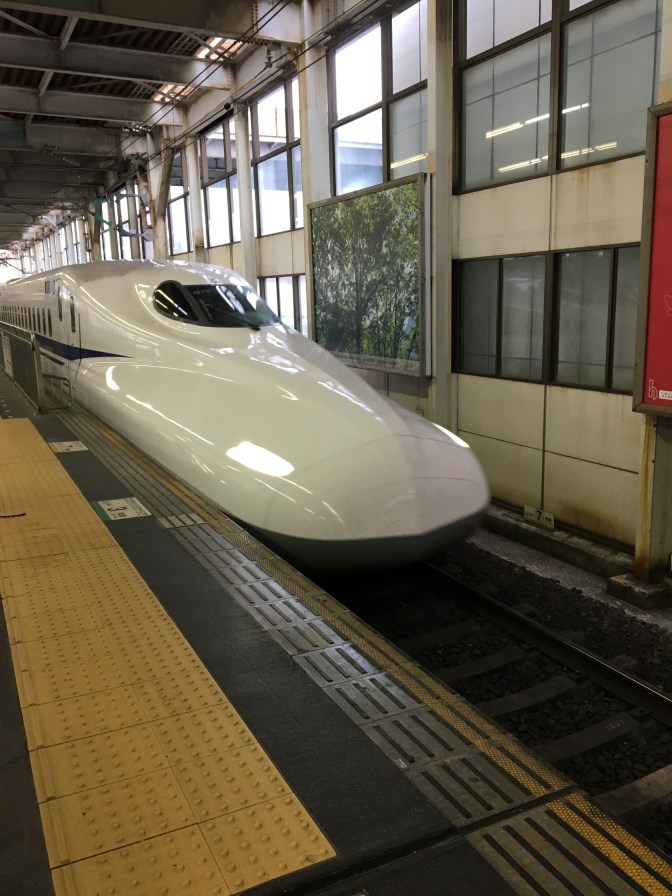
We loaded our train, taking up most of the priority seating (old people and those with small children, plus we made Sai’s brother Id pretend to be disabled), and blocked the entire back of the car with all of our luggage. Then, this incredibly rude young Japanese lady ordered us to clear a path to the door so that commuters could get from one car to the next. She also reprimanded us for allowing Teddy to stand on the cushioned seat with his shoes on (in our defense, the boy doesn’t walk yet – those shoes were not touching the ground). Playing the part of the ugly American that I am, we pretended not to understand this woman’s limited English and ignored her. Just kidding. The girl was extremely polite and apologetic in her simple requests, and we acquiesced accordingly. When she left the train a few stops later, she apologized again for possibly seeming demanding, and wished us well on the rest of our trip. Zamperini and Truman really broke their fighting spirit.
Castle
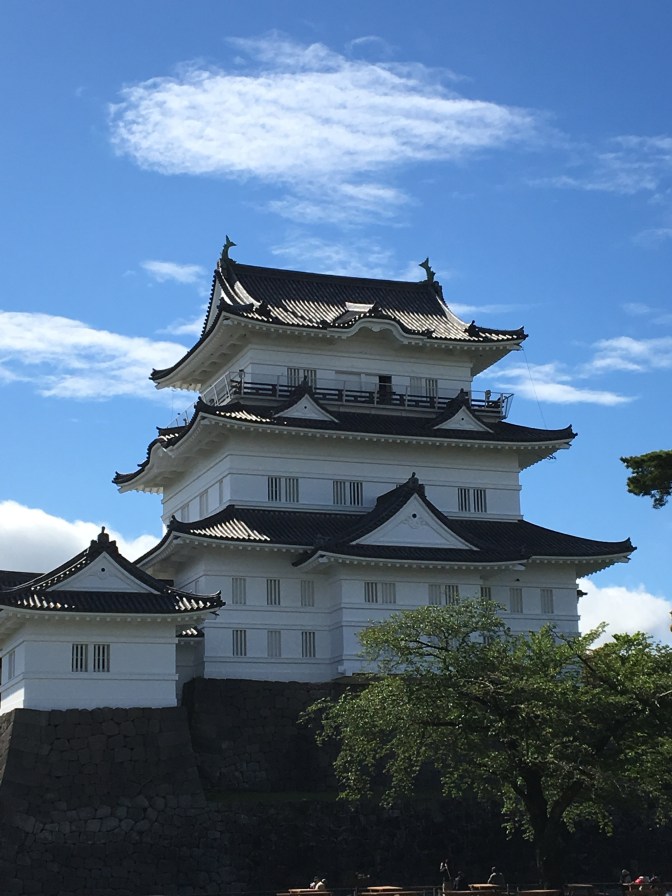
The train station in Odawara is the transition point between Tokyo and the final destination in Hakone. FYI – it is pronounced Hack-O-Nay, not Ha-Cone, or so Sai told me. Meanwhile, Sai’s father decided to play sentry to our luggage while the rest of us left the station to check out the Odawara Castle a few blocks away. The seventh largest castle in Japan, this reproduced building was constructed in the 1960s and renovated again a few years ago. This is a recurring theme throughout the old country, where old buildings burned (or were bombed) over the centuries, but were rebuilt in the same style, except here they added air conditioning and lighting and tchotchke souvenir stands. Why wouldn’t they build their castles out of stone or brick and mortar? China’s Wall wouldn’t have been so great if a simple match could light it like a fuse. Regardless of its faux age, it was a nice place to escape the trains on a nice day, traveling much lighter while Grandpa Wichgool watched our bags in a fortress of his own.
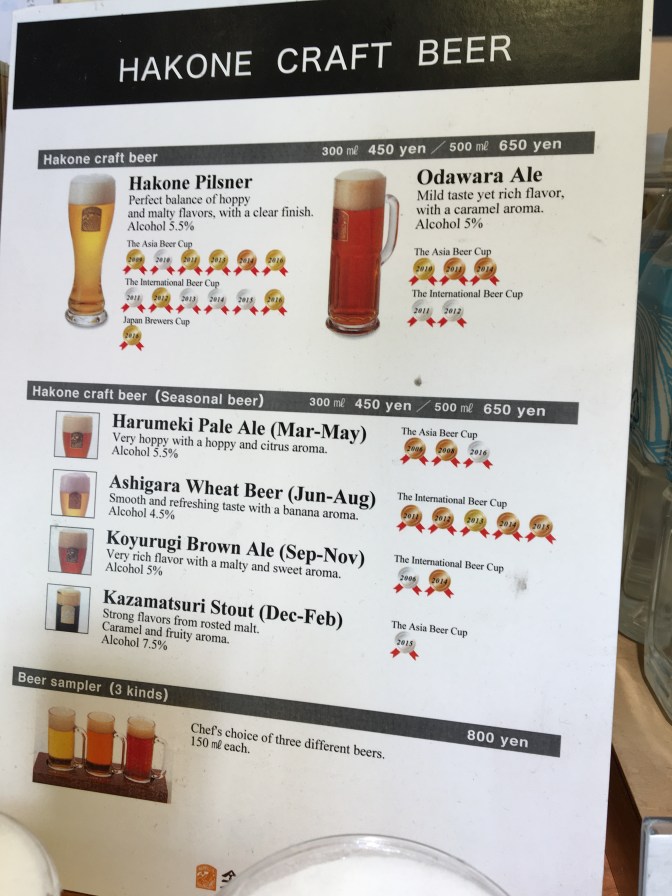
The highlight was a small shop selling Hakone Craft Beer just down the street from the train station. On the return walk from the castle, I tried their award-winning Odawara Ale, and it was noticeably craftier than the usual Asahi, Kirin Lager, or Sapporo. Id preferred the Hakone Pilsner. Kanpai, Japan! Id and I made it a point to revisit on the return journey two days later as well. But before you call me a boor for forsaking sake for the sake of beer (you can call me a boor for any number of other reasons), know that I read online (so it must be true) that beer is the more popular beverage in Japan, not sake. And at least I was drinking local beers, and not imports like Heineken or Carlsberg (I saw both options), or god forbid, a Budweiser product (I didn’t see any such swill). I’ve tried sake before, and didn’t like it. Surely I should have given it a better chance, but with limited opportunities to imbibe, I opted for the ale I knew I’d enjoy.
A much slower train took us back and forth up the switchback mountainside, alternating crossovers with the train coming down that shared most of the same track, before we reached our destination in Gora. This small hub had a handful of restaurants that were all closed on a Wednesday, except for one small place that was full when we inquired, though we managed a table later that evening. The Gora train station is the last stop on the train up the Hakone Loop before you switch to the cable car to work your way higher up the mountain. More on the Loop tomorrow. The train station also has a public toilet that may or may not contain fish.
Ryokan / Onsen
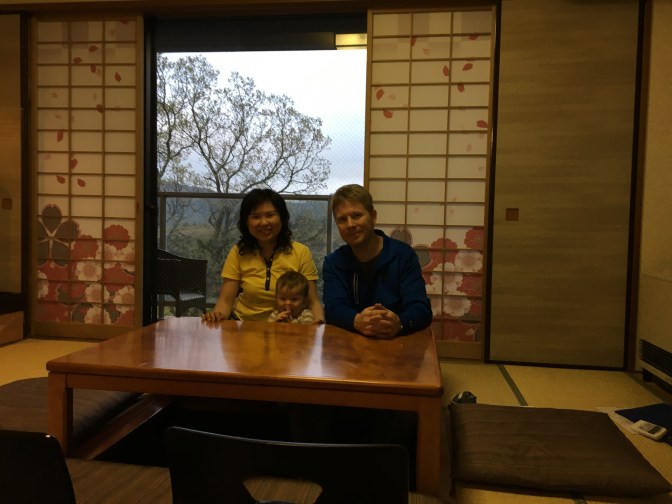
After checking into our ryokan style hotel (think normal hotel, except inside the room, there is bamboo(?) matting on the floors (you take your shoes off as soon as you enter), with futon-style mattresses you move to the floor for sleeping on. In the kitchen, there is a recess in the floor under the kitchen table, so that when you’re sitting on the floor, your knees aren’t hitting the low table. (The lone open restaurant floored us at a similarly low coffee table, only without the underlying floor recess, such that I had to uncomfortably try to sit Indian style (or whatever the less offensive PC term is for it). Okonomiyaki for dinner – an egg pancake with savory meat toppings, also known as a Japanese pizza). The hotel also featured an onsite onsen, his and her hot springs to sit around naked with a bunch of Japanese (or Thai) guys. Though when I used the facility on this first evening, I had the place to myself. They give you yukatas to use going from your room to the onsen. If you didn’t know, a yukata is not a peninsula in Mexico. It is just a cotton kimono.
PRC = 0! (The ugly American comment was not necessarily based on our ugly President. And the Bud comment is not anti-Trump supporters, just anti-bad beer. I even refrained from commenting on Trump’s Wall or his shoddy, gaudy hotels when questioning the Japanese construction materials.)
Day 5 – Thursday – Hakone
Waking up in our tight little ryokan, with its papier-mache thin walls, I thought our room had been overtaken by bears. Apparently snoring runs in Sai’s family, because each of them seemed to be trying to over-snore the next. What a weird competition. And in case you were wondering, if given the choice between a Tempur-pedic bed and a pad on the floor, I’ll opt for the first one. The good news at this time was the revelation that we could pass Teddy off to his distant relatives to get a break first thing in the morning. Grandparents don’t like to sleep anyway. Even with the extra hands, it took us a while to get going, but we finally made it out the door and over to the cable car that would carry us up the mountain as part of the first leg of the Hakone Loop.
The funicular lifted us up to the next transition point, where we boarded the aerial tram that would carry us over the backside of the mountain, to the next checkpoint overlooking a dry portion of land with billowing smoke coming out of it. Warning signs in line for this ride warned “Volcanic activity around Owukudani crater is causing volcanic gas to be emitted…. There is also a risk that even small amounts of volcanic gases might set off an asthmatic attack in sensitive customers (including… newborn babies, and small children)…” Yada, yada, yada. Time to test how tough Teddy really is!

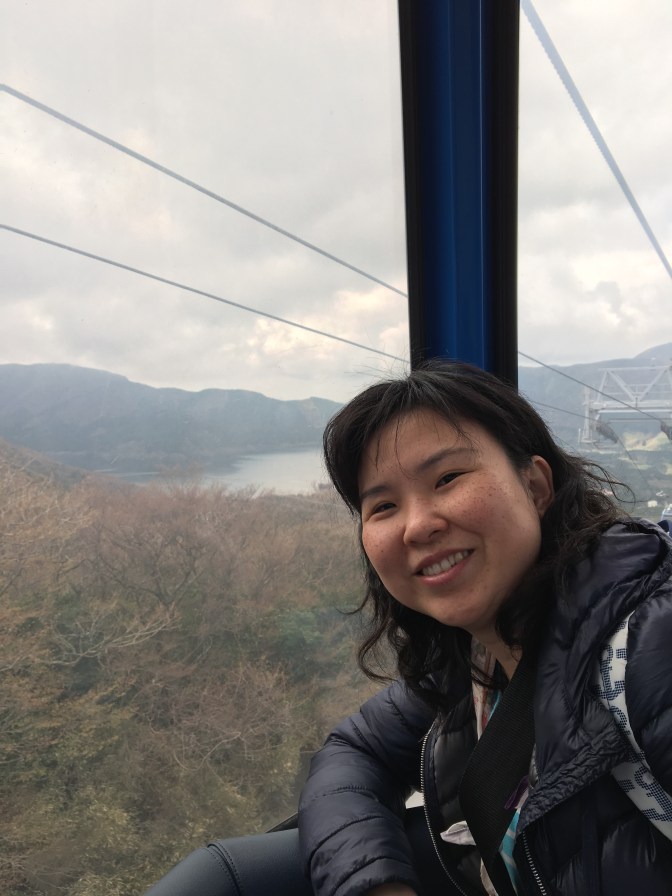
Holding our breath and overlooking the volcanic action below was pretty neat (almost said cool, but I’m guessing not). The ground looked like a strip mine. Not as attractive as the center of the volcano I was hoping to see. Teddy was unimpressed, unaffected, and I could breathe a sigh of relief as we boarded another aerial cable car beyond. This next leg was more scenic, with the surrounding mountains looming around us, with a distant Mount Fuji hiding to our right and the pretty Lake Ashi in front. The whole purpose of this Hakone trip was to see Fuji, but with the constant clouds, we caught maybe a partial glimpse at one brief point. Call it Mount Fu (or Mount ji, since it was the right side we saw). They reported that on a really clear day, you can see the Tokyo Skytree as well, but I didn’t see shit.
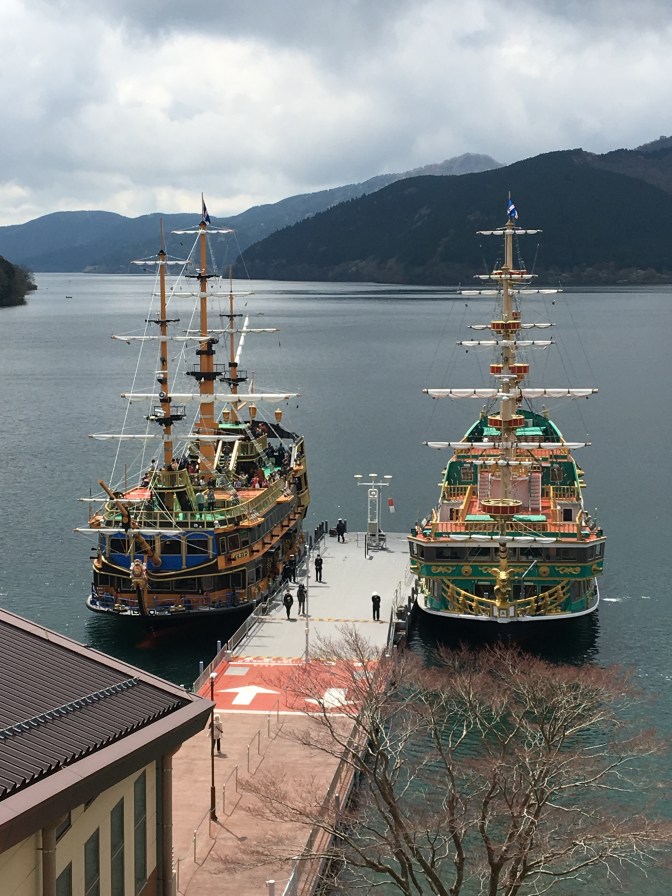
As this sky tram descended to the lake house, we saw the pirate ships that would carry tourists on the next leg of the loop. Lake Ashi was a serene setting between the mountains. The ship was loaded to capacity. The air was chilly. Teddy proved himself not to be asthmatic earlier, but this time he proved not to be a sailor either. He did not rak the boat (sorry to throw in Thai; I know this is about Japan. But rak means love, and rock the boat? Too easy to pass up). It was chilly and crowded on the boat, and clouds still meant no distant view of Fuji, so it was a busted boat ride. This is why Teddy was disappointed and moody for the water ride.

They deposited us on the distant shore, and we walked through a small village, picking up ice cream and heading toward a muddy forest of old cedars before deciding screw this, and hopping on the bus for the next segment of the loop. Not quite as exotic as a funicular, aerial car, ship or train, but the bus was reliable enough to take us over to the Hakone Open Air Museum. This ja-normous sculpture garden had some interesting abstract works of art. There was a giant chia-head. A giant mirror ball. A giant hand (piece named “Big Hand”). Some naked people. An indoor museum full of Picassos (kind of cheating for an open air museum, but okay). A crazy plastic diamond molecule thing that kids (older than Teddy) could climb in. A huge, wooden nest that looked like life-sized jenga pieces, inside of which were webs of colorful nylon netting, with hanging scrota containing big balls, like something Dr. Seuss would come up with. Like the diamond, kids were allowed to climb inside this contraption and play; Teddy was too young to throw inside the web, but he had a blast playing on some netted donuts below. (Hard to describe, but that’s abstract art for you). Whether you’re an aficionado of art or not (I am not), it was a beautiful place to spend a couple of hours outside on a gorgeous day. They even had a natural hot spring footbath, which was refreshing after a long day of walking.


We took the same train from the museum back to Gora Station that we’d rode in the day before for the final leg of our Hakone Loop. At Gora, Sai and Id searched for open restaurants. There were few options. I question how these tourist places can stay in business when they are closed most of the time, but maybe they burned out during peak cherry blossom season and were on their own vacations elsewhere while we vacationed there. It was frustrating, which Sai and I took out on each other in our worst argument to this point in the trip (I’ve tried sparing you previous petty disputes between us; rest assured, we still fight a lot when we travel. Kind of like we fight a lot when we’re at home). We finally found a small restaurant where they were able to strap Teddy to the table so that I had two free hands to eat, and it was wonderful.
After dinner, I volunteered to walk to a convenience store to buy diapers for Teddy. It was conveniently located right down the street from the Gora Brewery, so I thought I could kill two birds and some brain cells with one stone and some craft beers. Sai volunteered to come with me, which I thought unnecessary. She wanted to bring Teddy as well, which I thought inappropriate for the brewery. But who am I to argue?
I am who I am. After finding diapers, we found the brewery, and I argued when Sai said that I couldn’t get a beer. Wasn’t that the whole (half) point of this exercise? (Diapers being the other, less critical half – we could wrap Teddy in a yukata and leave it for the hotel staff if we really had to). Loser that I am, I lost the fight, and ended the night stone-cold sober, with an escaped bird that I wanted to kill (the metaphorical bird from the previous paragraph – I wasn’t suggesting that I wanted to kill Sai, I don’t think).
PRC = 0. Too sober.
Day 6 – Friday – Go to Kyoto
The onsite laundry beside the onsen proved less convenient than I thought it’d be, as the dryer refused to dry any of the clothes I tried cleaning the next morning (after waking early thanks to Teddy). I spent a couple hours waiting downstairs for the clothes to come clean and dry, which gave me time to stay away from Sai. For her part, she helped pack all of her things, leaving all of mine untouched until the shuttle was waiting outside, at which point I realized they were expecting me to race back up to the room and do it myself. Go team. My lovely wife and I picked up where we’d left off the night before, deeply in love in a pit so deep it might never see the light of day.
A shuttle van dropped us at Gora, where the slow train took us back down the scenic mountain to catch a faster train, back to Odawara (and another Hakone craft beer which helped more than you can imagine), before another fast train (shinkansen) took us across the Honshu Island to Kyoto, before a subway took us to the Shijo stop, before we had to walk ten blocks to the smallest house in Kyoto. First, let me clarify that the name of the stop is pronounced She-Jo, and should not be confused with shithole, as I’m trying not to insult foreign countries. Second, that was a long way to go via many modes of transport, lugging all of our luggage. Not complaining, just explaining why Teddy was complaining, and why we didn’t do too much else on this day. Teddy would experience his first flight, bus, subway, train, cable car, aerial lift and boat on this vacation. We couldn’t find him a motorcycle, helicopter or submarine to round out his travels, but we will soon.
The most exciting part of the ride was on the shinky (speedy nickname for the high-speed train never used by anyone before or since this paragraph) was a glimpse of the elusive Mt. Fuji out the window! F-U, Mount Fu!! Such a tease. Because shinky was so fast, the view was gone before I could react to get my camera out to take a picture. (Actually, there might have been time if I wasn’t busy trying to keep Teddy from climbing over the seat onto some strangers on a train).
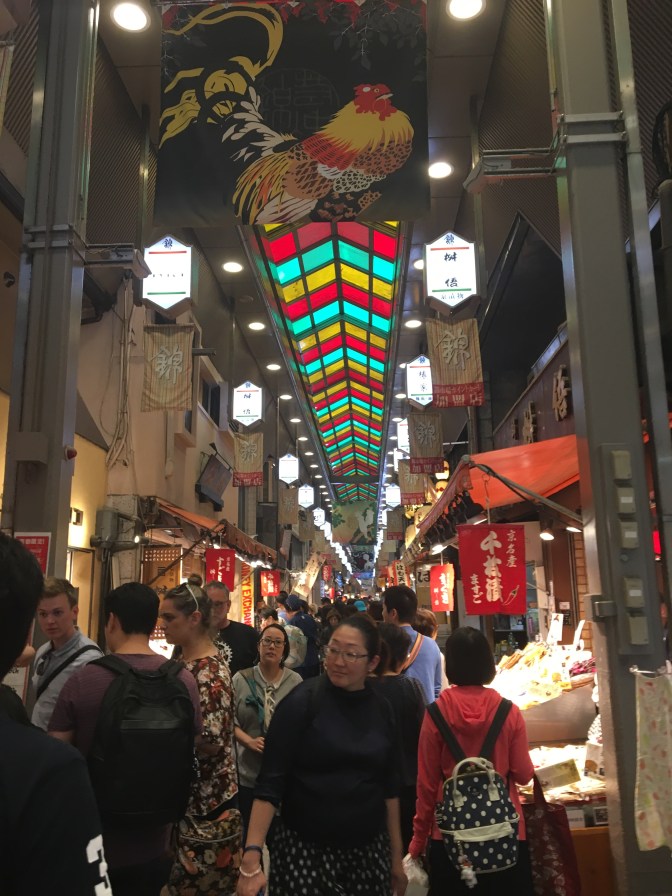
We did hit up a hot shopping street nearby (Nishiki Market), where we again sampled all kinds of awesome street foods. I had burdock on a stick! What the hell is burdock? I had no idea. Everything else on a stick was translated from squigglies into an English word I knew (such as Octopus or Chicken), so I opted for the unknown, and it tasted like a baked fish stick. Burdock is actually some type of root, so I’m guessing it was mixed with a nameless fish.
Sai and her brother fought with the staff at an inconvenience store where the long lines and tax breaks were not being clearly communicated by the store employees, while Teddy and I hung out people watching outside. (For fuck’s sake Id, sorry the salesgirl sent you to the wrong line and wasted five minutes of your time, get over it!). But at least food and diapers were not hard to find so far in Kyoto.
PRC = 1.
Day 7 – Saturday – Shrine on
Japanese Fleas
Similar to my impeccable timing for Tokyo sumo, I’d found a flea market at the Toji Temple that only occurs once a month, that happened to coincide with our first full day in Kyoto. Sometimes it’s better to be lucky than good, which is good for me, because I’m usually pretty bad. Thais love flea markets! Apparently so do Japanese, because the place was packed. It was 80+ degrees F, and even hotter when you’ve got a sleeping bun in the bjorn. The shrine itself had the requisite old-fashioned buildings (surely rebuilt after many fires), a steep pagoda with a big spire on top, places to offer prayers and benedictions and other mumbo jumbo that I cannot speak to, etc. They also had vendors hawking all kinds of Japanese crap: kimonos, trinkets, jewelry, artwork, hats, sunglasses, and foods (I had another taiyaki, stuffed with custard this time. Good stuff! Fish waffles are awesome. As long as they don’t have any fish inside them, because that just sounds gross).
Torii story
Next we went to the Inari Shrine (Fushimi Inari-taisha), where they have more toriis than you can imagine, unless you spend a lot of time imagining a bunch of orange portals as far as the eye can see. Id told me that there are supposedly over 10,000 of the things at this shrine, and I intended to count every one of them. But I lost steam after the first few. Id, grandma and I walked the early part of the path through the early toriis, while grandpa rested and Sai fed Teddy. When Id gave me the rough count, I tried extrapolating. The early ones were roughly a meter apart. 10k would be 6.2 miles of walking. NFW. They closed the gap and had a series of toriis closer together, but even a foot apart would mean over two miles of the stuff. Outside of Inari, you’d have to ride along the Trump campaign tour to see so many sets of arches (weak McDonalds joke).
If a torii symbolically separates the sacred from the secular, then wouldn’t passing from one to the next have you in then out then in then out…? Typically, you’d have a big torii at each entry point to the shrine, where you’d come in under one and leave out another on the opposite end. With them packed together, I couldn’t discern the Shinto significance of each step, but I was determined to tackle the challenge of completing the circuit. Grandma Wichgool was next to give up, leaving Id and I to keep going. We reached a nexus, where a local said that it was an hour loop to return to that point; challenge accepted! No way would Sai patiently wait for an hour, so I stormed up the path at double time, as best I could guess it’s meaning from military parlance gleaned from too much TV. Id quickly fell off pace, and shortly after called it quits. I accelerated, racing up this orange paneled mountainside, noticing that the stations selling water along the way were getting more and more pricy the higher I went.
When I reached the top, I was greeted with a faded sign that said Top of the Mountain. H. 233m. (It felt a little higher). There was another holy point with guard dog statues (not very effective for keeping me out), and a bunch of people, so I snapped an unworthy pic and hurried on, hoping to get back before Sai could make my life less pleasant for making her wait (she has the patience of a shuttered hospital). Fortunately, I found Id on the backside, and he was disappointed to learn that he’d given up only ten minutes from the disappointing top. Safety in numbers, as Sai couldn’t single me out for blame if her brother was just as tardy. Farther down the path, we found Grandpa W! Clearly he’d had enough of her complaining too and wanted to explore the orange arches. Now we were three! We hit the 60-minute circuit in 30, so my double time actually worked, and from there I could slow down and really focus on each torii. Some were really special. No, they all kind of blended together.


Back to our Shijo home, we put the parents and baby to bed and three of us went back out to see the crazy Kyoto nightlife. Sai wanted to take us to see geisha, but apparently the places that offer this tourist exploitation are expensive and require reservations. So we skipped this offensive objectification of Japanese women.
The Yasaka Shrine in Gion was open at night (since the toriis lack swinging doors or roll down garages, I guess most shrines are open at night?). We walked through this ancient temple, seeing more of the same bells to ring your prayers to gods, chochin paper lanterns, and thankfully far fewer orange toriis.
Gion is a popular neighborhood with quaint, overpriced shops, restaurants and teahouses along the scenic Shirakawa Canal. But if you’re not into overdressed geisha and overpriced family establishments, it’s also a red light district. And if you’re not into that either (or you’re not Japanese, as they seem to only solicit locals), you end up at Issen-Yoshoku, a local restaurant that promises five (5!) famous beauties in kimonos and addictive food in their version of okonomiyaki (the only menu option). The five smiling girls are mannequins, but I will concede that they looked attractive enough, and the issen-yoshoku signature dish (with beer chaser) was awesome! Some of it may have been hunger worked up over miles of speed-walking under orange toriis in the heat, but after the first Japanese burrito (that’s what it looked like to me), I ordered a second (and a second beer, naturally). Gion may have real geisha or smiling girls in less than kimonos or fancy restaurants with prices to match, but for my (Sai’s) money, Issen-Yoshoku was a winner.
Day 8 – Sunday – Kyoto again
I started this day with a super weird dream, which has nothing to do with Japan, but I’m sharing it anyway. In my dream, I was working with a new project manager at work, and though competent, the guy was driving me nuts with his textbook responses delivered in a nasally sing-song rhythm. What was up with this rising and falling speech pattern? Then I awoke, and immediately recognized the song as Sai’s snoring!
Because we saw them all the day before, we could leisurely enjoy Kyoto without worrying about seeing more toriis and shrines and such. Except that’s not possible.
Golden Pavilion
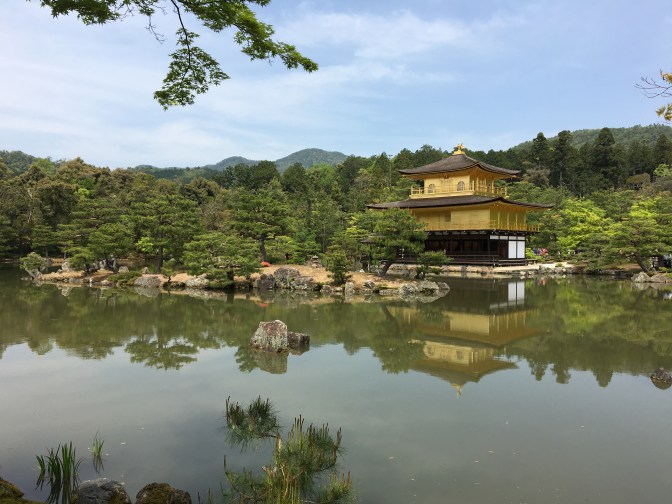
The Temple of the Golden Pavilion (Kinkaku-ji) is another historic-looking building that looks like it dates to 14th Century, but the present building was actually built in 1955 (after the original was burned to the ground). This tourist trap had the most people anywhere outside of Tokyo, based on my quick count. It is a gorgeous temple, covered in tasteful gold leaf without looking like a tacky Trump tower, set on a serene, still, reflective pond, with simple Japanese garden style landscaping around.

Kyoto Imperial Palace
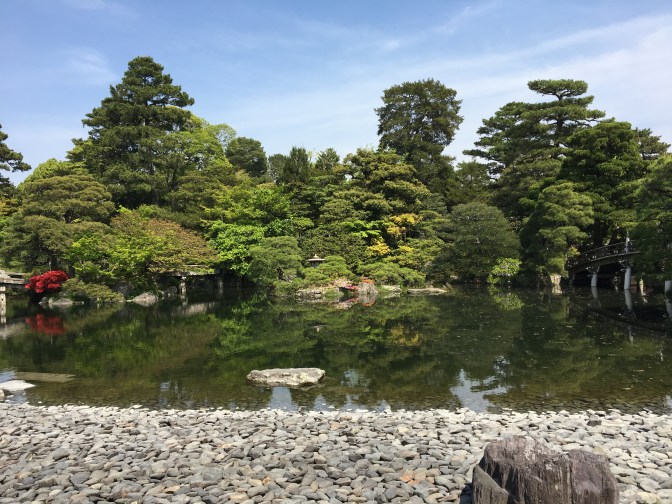
The Imperial Palace of Kyoto is not to be confused with the distant shithole in Tokyo, previously described on Day 3. This one actually lets you get closer than a kilometer away! It’s a huge complex, with outer walls stretching on forever. The gravel lot around the wall is a pain in the ass to push a stroller across, FYI. Inside, we arrived an hour early for the English-speaking tour, so we walked without it, touring around the different palace buildings with nothing to rely upon but the signs in English, so it wasn’t a completely lost cause. There are a series of buildings and temples that served all kinds of purposes for the imperial forces: guardhouses, guesthouses, meeting rooms, bedrooms, etc. Some of the spaces were open to look upon from the outside. None of them were open to enter. The gardens were immaculately groomed down to the last detail. Sitting upon a bucolic bridge (closed to visitor foot traffic), a crane posed for pictures for people with better zooms than my iPhone.


Bieber’s Bodyguard
Riding the city bus back to our Shijo-dori corridor, Teddy hid in the backpack version of his carrier for a quick nap. Except where’s the fun in that? I was given a priority seat with the baby on my back, while the rest of the family scrambled elsewhere on the crowded bus for sitting room. Meanwhile, Teddy peaked out from behind me to catch the attention of some Europeans seated around us, flashing his charming two-toothed smile. As the bus bustled along, it picked up more and more locals, including a group of schoolgirls (fortunately not dressed like Gogo), who fell in love with the kiddo, who milked the attention for all it was worth. I hunched over to hide from view like Quasimodo, and Teddy turned from side to side, smiling for one set of girls then the other, all of whom cooed and giggled each time he turned their way. I haven’t received that kind of attention from the ladies since… okay, I’ve never received that kind of attention. But in my defense, I’ve never been as cute as Teddy.
Dumb Ape
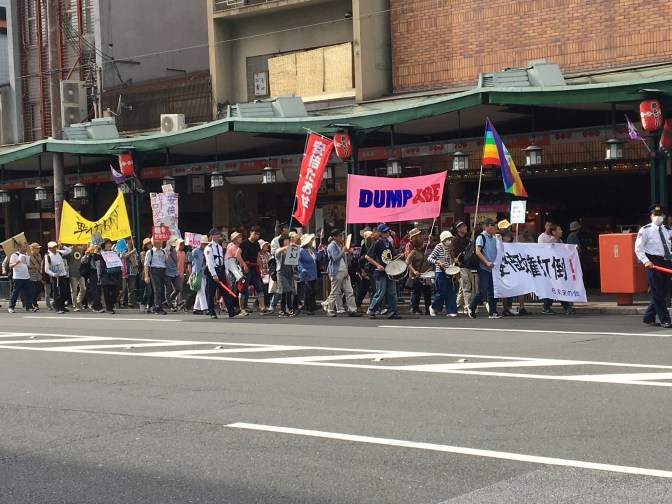
Unfortunately for Teddy, his glory ride had to end before he reached an age to truly appreciate the attention of the young ladies. We disembarked near Gion to check out yet another shrine, because that’s what you do when you go to Kyoto. First, we witnessed a small protest drawing attention on the busy street, as a group of people carried signs and shouted slogans ostensibly blasting some guy named Abraham. Dump Abe lacks the rhyme of Dump Trump, but Japan’s PM has his own yellow stream of detractors (DJT pee joke, not about Asian skin color). Not sure why one sign read #We Too, because to my (limited) knowledge, Shinzo never rode the short bus with Billy Bush; Abe did once get in trouble for saying the Korean “comfort women” were asking for it, more or less, which sounds like something our guy might argue. And he’s said that Japan should no longer have to apologize for its role in WWII. Abe’s got approval ratings like the ones that Trump pretends he doesn’t have. He engaged in some questionable land deals / cronyism. He’s tried to do things with his Self Defense Forces that seem to exceed the pacifist constitution, which he also wants to change. I’m guessing the ninja-judo warriors will learn some attack maneuvers. And he once visited Yasukuni, which is a big no-no, unless you’re there for the free sumo. And he was the first world leader to embrace the Donald. Not sure which of these issues led to this little revolt. But relax, Japan, it could be much worse. Trust me. FWIW, maybe Frappe Abe for future signs?
Kiyomizu-dera
Next on our list of things to do in Kyoto was a Buddhist Shrine. Because we hadn’t seen any of those yet on this trip. We followed the mass pilgrimage up a long hill to the Kiyomizu-dera Temple, where we saw more of the same as the other temples. There are great views of the city, and scenic surroundings. Unfortunately, they charged a cheap admission to the main temple itself, so I skipped that part. The worst part was that we were in such a rush to reach the ten thousandth shrine (I lost count days ago), we blew past the Kyoto Brewing Company on the way. I really wanted to Shogun a few beers.


Bamboozled
Because Sai and her brother decided that we had to complete everything imaginable on this day, we left Kiyomizu-dera, headed back to town, used multiple modes of public transportation, and JR Passed it over to Arashiyama for the last light tour of the famous bamboo forest. If you love bamboo, then this is the place for you. If you find the weedy grass annoying because it keeps creeping into your yard from your lazy neighbor’s property, (not the good kind of weed or grass), then the forest may be less impressive. We only covered a portion of it, because daylight was winding down, so maybe a few more miles would have impressed me more. There is a pretty riverside in Arashiyama as well, and we surely could have gotten more out of the excursion (45 minutes from Kyoto), but it was a long day.

PRC = 3, but they were all in the same paragraph.
Day 9 – Monday – Hiroshima
No weird dreams of snoring Sai on this day, but Teddy woke us up sometime after 4, because that’s what he does now. Before settling back to sleep, I tried to figure out why the smoke detector above our bedding (mattresses on the floor) was flashing rapid blasts of blue, instead of the steady blue that it was before. Was this a carbon monoxide sensor? Was the flashing a sign of alarm? There was definitely no corresponding sound, because Teddy’s recent ruckus told me that I hadn’t lost my hearing during the course of the night. Sai seemed unconcerned and went back to sleep beside the baby who either fell back as well or passed out because of some dangerous compound slowly killing us. Googling failed to tell me much, but suggested a similar looking contraption would blink for a short time to indicate low battery. I timed the blinking, learning that it was one minute of rapid blink for every four of solid blue. (The battery indicator was something like 15 seconds per minute). Evacuating the house seemed excessive. Waking the sleeping bears snoring around me would be difficult and ill-received at this ungodly hour. It’s bad enough when Teddy does it. Alas, after close to an hour of searching and researching and counting and recounting, I decided that we would survive. And if you’re reading this now, then you know that I was right (there’s a first time for everything).
On a less cheery note, on August 6th, 1945, at 8:15 a.m., approximately 70,000 people were instantly incinerated by the first ever atomic bomb dropped above Hiroshima. Double that tally for the fires and radiation and other effects following the initial blast. So 140k of the 350k estimated population (or as high as 180k) were killed by the Little Boy dropped from the Enola Gay. Nagasaki followed three days later, and was also quite lethal, and Japan’s formal surrender to end WWII was five days after that. Hiroshima’s B-29 bomber was named after its pilot’s mother, which seems like a horrific honorific to me. “You think your mom’s da bomb? Well, my mama is da bomba!” (Even though Tibbets was not from Boston, I gave him the accent for the sake of the rhyme).
72 years, 8 months and 16 days after the initial event, I planned a solo visit to the city of ashes. Like all good plans of mine, my better half changed them and decided that rather than joining her family for a heartwarming jaunt to Nara, where free-ranging deer frolic through the charming old city, my dearest wife and child would spend an extra hour each way in transit to a more distant, depressing place of atomic destruction.
Impressively, much like the mythical phoenix, a large, sprawling city of over a million people has arisen from the devastation of the last great war. Hiroshima is the eleventh largest city in Japan. It would rank tenth in the US, FWIW (though the less mythical city in Arizona still beats it by around a half million old people).
The Hiroshima Isotopes Carp baseball stadium looked inviting, if only for a flash before the shinkansen was past it, and their team gear was on sale everywhere. They rebuilt their old castle to its former glory (after it burned down along with most of the city in 1945), and it now houses a samurai museum. There’s an art museum, scenic rivers, a lively downtown, and several other worthwhile places to visit if you have more than a couple of hours to spend there. But if your wife decides to tag along, along with a ten-month old baby, then the day’s plans are (dare I say?) blown up. That’s why you go alone.
Unfettered from my favorite family, I planned to be out the door well before eight, to arrive in Hiroshima by 10:30 or 11, hit the sad sites, and have time to head over to Miyajima in the afternoon to catch the O-Torii gate “floating” at high tide. It’s reputed to be one of the most scenic icons of Japan, behind that stupid Mount Wannabe Goodyear that hides behind the clouds when you go to Hakone four days earlier. Then back to Hiroshima, grab a few craft brews at Raku Beer (but hopefully not get bombed… too soon? It’s been like 70 plus years!), hop back on the shinkansen and be back to Kyoto before Teddy’s bedtime.
With the wife and child in tow, we didn’t leave the tiny house until after nine, argued about how best to get to the train station, hopped on the wrong train (right destination, but not one that was supposed to be covered with our JR Pass for some reason; fortunately, no one questioned us or kicked us off), and reached Hiroshima around noon, when we had to find food. Along the way, once she realized how quickly the high speed rail traversed the distance between Kyoto and Osaka (15 – 20 minutes, which I had told her beforehand but she never listens…), Sai suggested a dinner stop in Osaka to meet up with Thai-based friends who were visiting Japan and staying in Osaka. During this trip, Sai also felt it worthwhile to tell me that I lacked the street smarts to survive in Asia, and that I’d be a prime target for her to take advantage of in Thailand. Good to know.
The city tour bus (comped with our JR Pass – Sai found that bargain) dropped us off at the Atomic Bomb Dome around 1 p.m., from where I cycled through the nearby monuments (Memorial to Mobilized Students, Children’s Peace Monument, The Peace Bell, Pond of Peace, Flame of Peace, The Cenotaph, and the Hiroshima National Peace Memorial Hall for the Atomic Bomb Victims). These are all basically right next to each other in the Hiroshima Peace Memorial Park, with the dome at the far top corner, and the Memorial Museum at the opposite end. The museum is under renovation, so the displays are temporarily relocated, but after the aforementioned list of sites, I’d seen enough, so I skipped the museum, knowing that neither Sai nor Teddy would get much out of it. As it was, we would be pressed for time to get to Miyajima in time to get back to Hiroshima again to catch our train back to Osaka. So we scrapped that stop as well. But no worries, even though I wouldn’t get to take a picture of the astounding gate to the Itsukushima Shrine (erected in 1168), I later saw its image on the wall at Dulles outside the international arrivals area, alongside such other mundane architectural blips as the Eiffel Tower and the Great Wall of China. (Way to rub it in, Dulles). Kind of breezed through that without stopping for a breath, didn’t I? That’s how it played out.
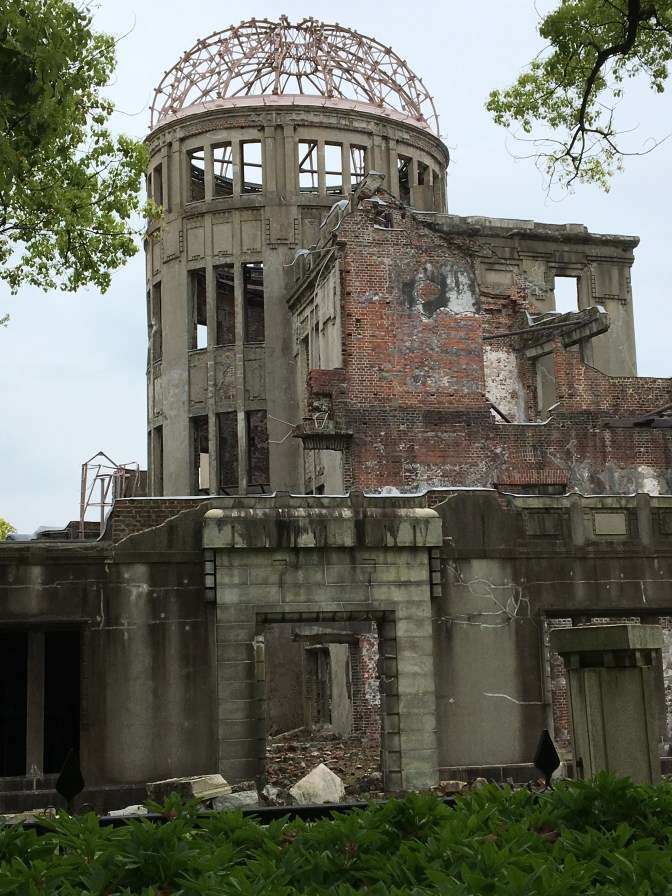
More detail: The A-Bomb Dome is a shell of a structure with brick and rubble and dangling spiral stairs, and supporting steel framework holding the whole fraction of a building in shape to represent what was left over after the big blast ~1900 feet above and a hundred meters away. Everyone inside was instantly killed, but the structure was somewhat left intact in ruins that are maintained to this day as a reminder of the carnage. It’s incongruous to have pretty flowers around the outside of the fence separating spectators from the site, and seemed even more wrong to pose with a big smile in front of the dome, but then again, I generally don’t like to smile anywhere.
The Memorial to Mobilized Students acknowledges the millions of kids who served the wartime effort, many of whom gave their lives in the process. In Hiroshima, 4,000 such students died while working to create firebreaks in town, which proved worthless anyway when half the city caught fire from the bomb. The five-tiered tower has a statue of the goddess of peace at its base, with colorful garments hung along the side and fresh flowers at the bottom of the structure. There’s a wall behind with reliefs of conscripted kids hard at work for their losing cause.
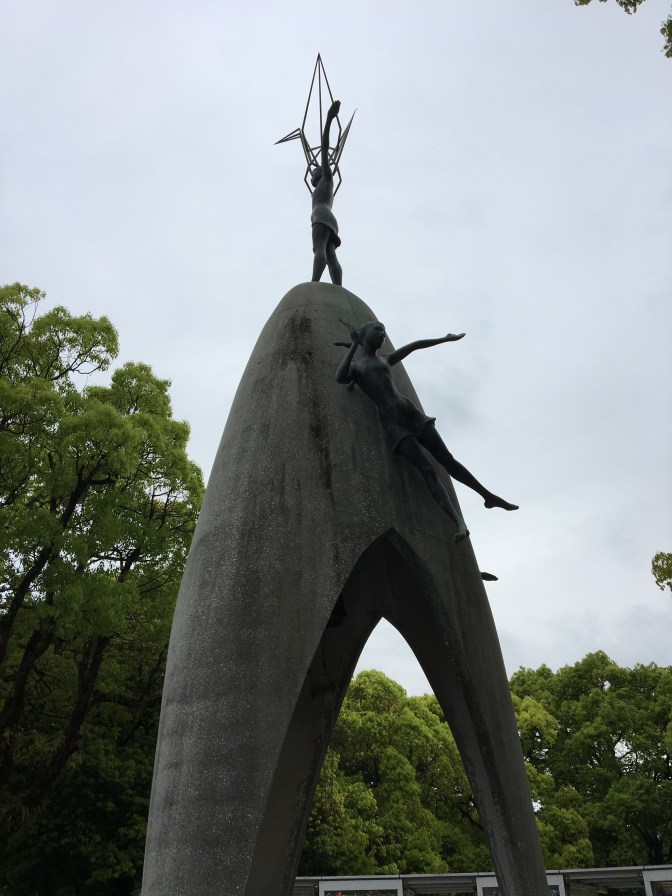
The Children’s Peace Monument was inspired by the death of Sadako Sasaki, who died of leukemia ten years after “surviving” the atom bomb as a 2-year old. The 12-year old girl learned of a legend that you could cure illness by folding a thousand paper cranes (a sacred bird in Japan), but she perished after 644. Atop the tripod concrete sculpture, a young child stands holding an origami crane triumphantly above her head. There’s a bell inside the monument inscribed with “A Thousand Paper Cranes” and “Peace on the Earth and in the Heavens.” http://www.hiroshima-is.ac.jp/?page_id=230
The Peace Bell has a domed housing (much more solid than the skeletal remains of the A-Bomb Dome) above a big bell that you are welcomed to gently strike to “ring to all corners of the earth to meet the ear of every man, for in it to throb and palpitate the hearts of its peace-loving donors…” Unfortunately, while they’re trying to protect their precious bell, you can’t exactly ring gently and reach every ear. But it’s a noble aspiration.
The Flame of Peace sits atop two upward opening hands (in abstract form) as if to say WTF? The flame is to be extinguished when the world is free of nuclear weapons. The pond floats under it. Japan is not a nuclear power, and technically, they are a peaceful nation without an army (just a self-defense force). The current nuclear powers (per the Federation of American Scientists – https://fas.org/issues/nuclear-weapons/status-world-nuclear-forces/) are US, Russia, France, UK, China, India, Pakistan, (somewhat secretly) Israel, and (not-so-secretly) North Korea. If DPRK / little rocket man is serious in his recent talks with South Korea, this list could shorten by one. But our dotard is going in the opposite direction, so don’t expect the flame to go out anytime soon.
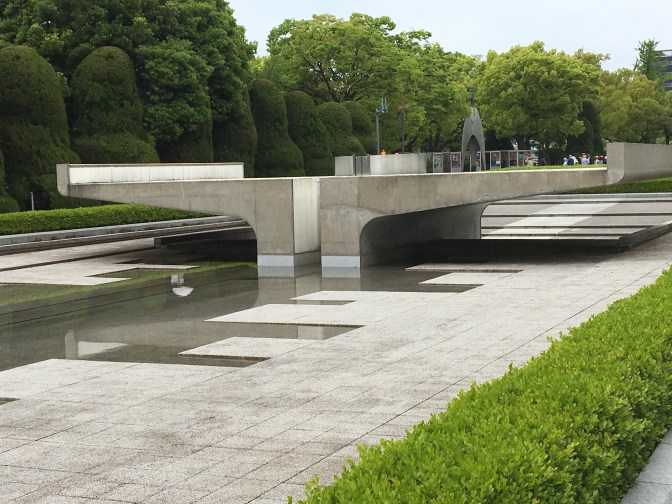
The Cenotaph is a stone tunnel with a central stone vault containing the names of all those who lost their lives from the bomb (either in the initial blast, subsequent fires, radiation poisoning, cancer, etc.). You can look through the cenotaph, across the pond, over the flame, and to the dome, as they are all aligned.
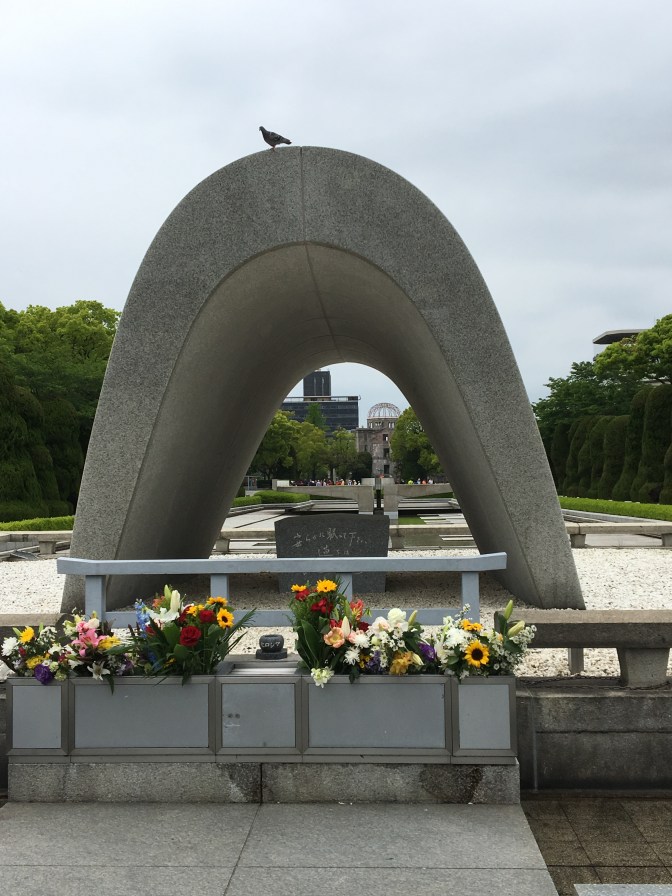
Inside the memorial hall, there is more of the same type of depressing information. The Japanese seem sincere in copping to their own bad policies leading to the explosive end to the war, as well as in offering these monuments not to present themselves as innocent victims, so much as to express a message of peace to prevent similar destruction anywhere else. Sounds good to me.
We returned to the train station with ample time to wait for a shinkansen back to Osaka to meet up with friends, but insufficient time to do much else. While we could have possibly rushed over to Miyajima, it would have meant a later train, a more tired Teddy, additional stress, and aggravation best left avoided. In Osaka, we enjoyed another ramen meal for dinner with friends who told us how great their daytrip to Nara was. Does no one care about history? I had proposed fugu for this Osakan meal, but people thought it crazy to spend outrageous amounts of yen for a dish that doesn’t even taste that great and has the potential to kill you. Pufferfish chickens.
And FYI, in case you were wondering, the ambient radiation in Hiroshima averages the same as anywhere else in the world. Because the bomb was detonated high up in the air (as opposed to on the ground), the mushroom cloud spread the nuclear fissionable bits into the atmosphere where they spread over greater distances and quickly became inert before falling out of the sky (fallout). https://zidbits.com/2013/11/is-nagasaki-and-hiroshima-still-radioactive/
So for those keeping score, I may have subjected my son to steaming hot soup on several occasions (damn ramen), volcanic gases (Hakone), potential carbon monoxide poisoning (Kyoto Shijo), and latent radiation poisoning (Hiroshima). Yet every time I put him down, Teddy comes butt-scooting (his version of crawling) back to daddy. He’s more loyal than Hachiko! And before you add horrible father to previous pejoratives like horrible husband and horrible travel writer, “yeah, well, that’s just, like, your opinion, man!” (to quote The Dude).
PRC = 1 (I deleted the part where I tried to pin the destruction of Hiroshima on Crooked Hillary, since she wasn’t born yet).
Day 10 – Tuesday – Kyoto to Tokyo (kind of like Nippon pig latin)
Teddy on the train again. The shinkansen is superfast, but it’s still a long ride for a child who has been out of his element for over a week, bounced around to different cities, passed around to distant relatives, subjected to different diapers, diet, and daily routines, forced to spend long hours away from the strange house with only nap options of sleeping in a back or front pack or on a bumpy roller stroller, and whatever other reasons Teddy felt frustrated enough to make this three-hour ride seem interminable. He wouldn’t clearly speak his pique, but we understood enough to appreciate that Teddy was tired.
In Tokyo, we split the group into those with blue passports (the Americans, which now includes Sai, whether she likes it or not), and the reds (the Thais, who were staying at a different hotel for their remaining week). While her family rested up and regrouped for the last part of their trip, Sai led us on a walkabout through the shopping areas of Shinjuku. Teddy took it upon himself to sleep like a baby in the carrier, while I sleepwalked through the motions of shopping with Sai. As much time as he spent attached to my chest, I felt like Kuato’s host from Total Recall, though I couldn’t get him to say “start the reactor”. Those would have been some creepy first words from Teddy, so it’s probably for the best that he did not quote the classic. In the hectic shopping area, there were enough neon signs everywhere for sensory overload. If you could add in the grime from downtown Bangkok to Tokyo’s glitter, you’d get Blade Runner. [I realize that I need to get some more current references. I’m like Ernest Cline, stuck in the 80s. Unfortunately, I don’t get out to the movies very often anymore, nor do I see much chance for changing this anytime soon.]
It was raining in Tokyo, but because there are so many people, you don’t really need an umbrella. If only half the people use their umbrellas, there is enough crammed coverage to keep the other half dry. It’s like herd immunity or something.
We reconnected the full group for dinner, and struggled to find a decent place willing to take our large party on short notice, before we ended up in the upper floor of a multi-story restaurant with plenty of capacity. And though it started out relatively empty, they filled up nicely to hear Teddy’s screams after finally waking up from his afternoon nap. These were not yelps of anger or hunger or anything more than pick me up and play with me, or I’ll make so much noise that you’ll regret it. Needless to say, it was another good meal ruined by the baby (for those keeping track or considering it, while it’s only been a little over ten months, I can assure you that these bundles of joy work woes on adult travel, eating out, drinking, … but I love my son).
Sai encouraged me to go out drinking with her brother, after we finally coaxed wild Teddy to sleep around 10 p.m., and for once, I didn’t feel like arguing. Id and I walked past many of the same places I’d passed earlier with Sai and Teddy, and for some strange reason, people kept asking the two guys if we wanted to see titties and other female action. Guess they didn’t feel like Sai’d be interested, but clearly they underestimated Teddy’s attraction to both boobies and Asian women. The red light district is right next to the shopping area near where we were staying. Several of the establishments clearly catered to locals only, but there were African touts who assured us they knew the place for us gaijin. I didn’t recall seeing more than one black person in all of our travels, so it was surprising to find so many all pushing the same services at this time*. For the record, I’d never go to one of the places these touts were promoting (with my brother-in-law).
*[I did see a very white guy wearing a Black Lives Matter tee shirt at another point in the trip. I won’t disagree with the message, but it seemed like the wrong place / audience to be sporting it. Why wax political when the people around you have nothing to do with that agenda? I would never interject my politics… Never mind. Maybe it’s more like if I were to wear an Eagles shirt (coordinating the day to match Teddy’s outfit). It’s not like anyone in Japan is interested in my team or sport… Wait, I’m not comparing the murder of unarmed black people by the people that are supposed to protect the public to a sport, even though it may seem like an American pastime to people in other countries. But it just doesn’t seem like a relevant issue in a place where the police I saw appear to be only armed with a short plastic baton that resembles a mini toy light saber, and to my knowledge, none of said police used said toy light sabers to kill unarmed African touts.]
Kirin City is a chain establishment offering all twelve of the major breweries brews, though I think their count is cheating. Half of their menu is mixed pours of the six actual original beers. By my count, having Guinness, Bass, and Black and Tan may be three different drinks, but it’s still only two different beers. Regardless, it was good to try a few options beyond their Ichiban and lager, two I’d already had. Id waxed anthropologic on Japanese culture (having been here before, he was more of an expert than me). He elucidated on their nationalist pride, and tried to explain the anime / cosplay scene, but I just wasn’t getting it. Are the late night bars full of TVs playing adult cartoons? Or are they full of people dressed up like cartoon characters? Kirin closed at 11:30, so I was able to get just enough buzz on without the worry of oversleeping or hangover for the 5:30 a.m. wakeup alarm to pack and catch a train to catch a plane back home, though I never solved the mysteries of Japanese culture (despite Id’s best to educate me on the subject). And for those who may be questioning it, Id really is the nickname of Sai’s brother (short for Idiot? I’m not sure, but it wouldn’t surprise me; my wife can be mean like that). Either way, he is not a Freudian subconscious concoction of mine that encouraged me to go drinking.
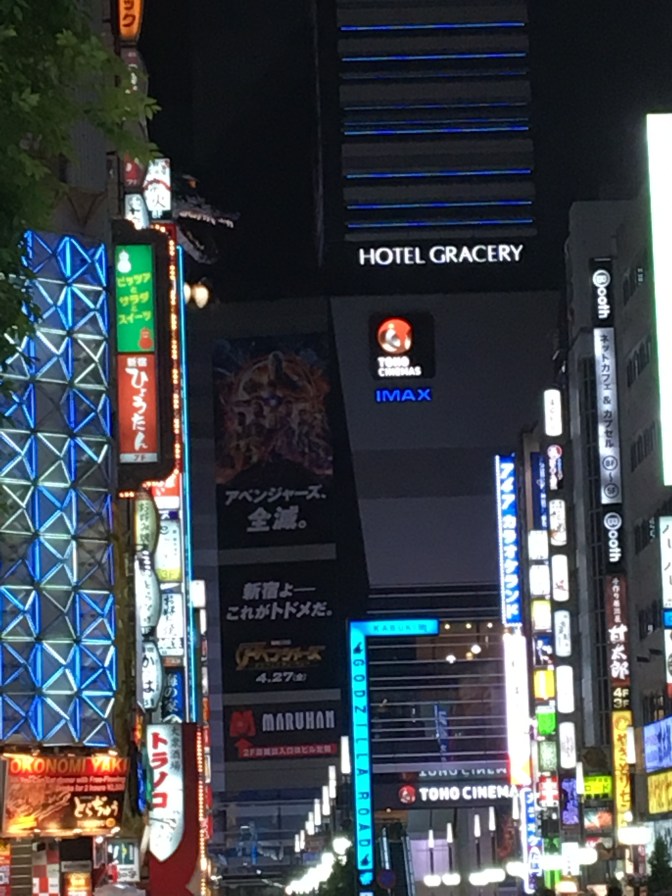
PRC = 1.
Day 11 – Wednesday – Fly back to USA
Did you know that you can go back in time? We left Narita at 11:30 a.m. on Wednesday, landing in DC at 10:30 a.m. on Wednesday. It’s almost as if the flight never happened. Wouldn’t that be nice? We’ll get to the repeated horrors of flying with Teddy in a moment, but first, time travel!! A twelve-hour flight against a thirteen-hour time zone adjustment equals an hour gained. It’s like being teleported, only becoming an hour younger in the process. Make this trip enough times, and you can go back and save Lois Lane! You can repeat the whole day all over again, hopefully without worrying about a hysterical baby being systematically slapped out of it by the fellow passengers on the Airplane! It’s like Groundhog Day, all over again. Unless the langoliers at border control decide to take away the day by eating up the gained time… Actually, clearing customs was painless. There were no lines at all to speak of at Dulles, and the whole process was so much faster than our processing at Narita ten days earlier. So much for Sai’s theory of superior Asian efficiency.
Teddy was his usual, charming self for the flight attendants, while our sweet angel grew horns when the lovely ladies were not around. In those darker moments, he wailed away whenever Sai tried to get him to sleep, only to be placated when my sympathies for our fellow passengers won out over her patience for tough love, and I’d pick him up and he’d start smiling and laughing again. Sure, street-smart Sai is right, and sucker-dad was being played by the devious boy, but you can’t subject the rest of the plane to a screaming baby when silence is just an arm’s length away. He continued the raging tantrums and aural assault on the eardrums of fellow passengers in the forty-minute shared van ride home (no cute flight attendants this time), before falling asleep for a short six-hour nap that screwed up his sleep schedule for the next few days. And street-smart Thai Sai misplaced her wallet when the van pulled up to our place, leaving me to pay for the ride. I’m such a sucker…
PRC = 0!
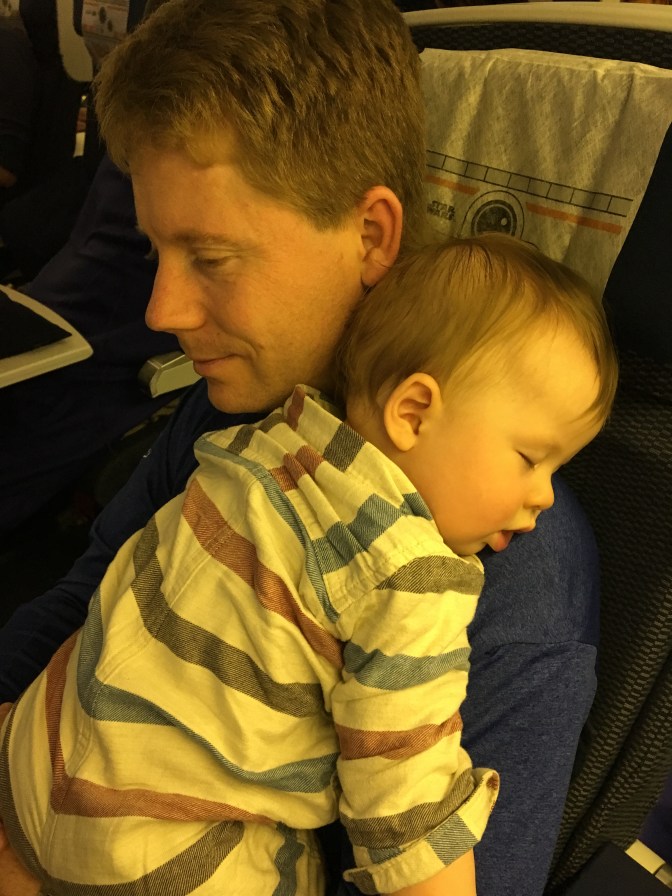
Final Thoughts
It was great to get out and enjoy another real vacation. Over the last year plus, the only “trip” has been the last ten months of Teddy. And though I love the kiddo, it hardly qualifies as a vacation. Japan is an impressive country. Everything was super clean, friendly, efficient, tasty. There is so much more to do than what we were able to accomplish in these ten plus days, which is a reason to go back again (and get better use out of the guidebook I bought that Sai complained I didn’t use). It’ll definitely need to wait until Teddy’s walking. Perhaps he and I can climb Fuji to finally really see the hidden gem, though by the time he’s old enough, I’ll likely be too old (and Sai will still be too lazy). And in case you’re wondering, I didn’t mention any specific special sushi. We only had a handful of pieces, usually as side dishes to larger meals.
Less than halfway through this one, Sai started asking about our next trip, trying to take advantage of the cheap airfare while Teddy’s (relatively) tiny. Since we survived another vacation together without bloodshed, why not keep going? It may be a bit unfair to Teddy to see cool places while he’s too young to appreciate or remember them, but he’ll be free to read long-winded reports of the experiences as soon as he’s old enough to understand my shallow profundities, cheap profanities, and endless inanities.
Sayonara.

 Traipse Reports - Trips and Races